


Season 1 · Episode 2 of 8
Some nights I sit at the foot of Luke’s bed until he falls asleep. It helps him settle. He drifts in and out, and every so often, half-dreaming, he mumbles a line from one of his favorite shows, laughs quietly at his own joke, and slips back under. The house goes still. One of our dogs snores on the bean bag next to us.
That is where I do most of my reading. Laptop open, the blue light on my face, the same stack of studies I’ve been through a hundred times. And it was there, late one night, that I found myself in the strangest argument of my life — with a machine that agreed with me completely, and told me in the same breath that it would make sure no one ever heard me.

I’ll get to that. But first I have to tell you about the dinner.
Four for four
For the last couple of years I’ve run a small, unscientific experiment. At the end of every hospital shift, when the incoming doctor takes over my patients, I ask one question: Have you ever heard that starting a prenatal vitamin before pregnancy is associated with lower rates of autism?
I’ve asked hospitalists. ER physicians. Psychiatrists. Pediatricians. Obstetricians. Even Uber drivers on the way to the airport. I once asked two of the most decorated physicians in a city where I used to practice.
The answer is always a blank look, followed by the same word. No.
About a year ago I sat down to dinner in Dallas with four old friends from medical school. Between the five of us at that table, we’d trained at one of the top medical schools in the country and stacked up more than a century of combined clinical experience. One is a pediatrician at a major Dallas academic medical center — he evaluates children for autism every single week. Two run elite concierge internal-medicine practices, the kind where families pay five hundred dollars a month just to be on the roster, the kind who get voted onto the D Magazine “Best Doctors in Dallas” list by their own peers, year after year. The fourth is a sharp, unflappable ER physician.
These are not careless people. If you were sick, these are the doctors you would want in the room.
Over appetizers, I brought up the research — the large studies, in our field’s premier journals, linking prenatal vitamins started before pregnancy to something on the order of a 40 to 50 percent lower rate of autism. [1–3] The pediatrician laughed. He was skeptical, and said so.
So we pulled out a phone, right there between the water glasses, and searched the citations.
Up came JAMA, JAMA Psychiatry, the American Journal of Clinical Nutrition. Studies done by Johns Hopkins researchers, funded by the NIH. [1–4]
I watched the skepticism drain out of his face and turn into something closer to shock. He put his fork down. He said he was going to walk into the obstetrics department at his own medical center first thing — why are we not telling parents this before they conceive? Especially the parents who already have one autistic child and are worried about having another?
The two concierge doctors — the best of the best, voted so by the people in the top position to know — had never heard it. The ER doctor had never heard it.
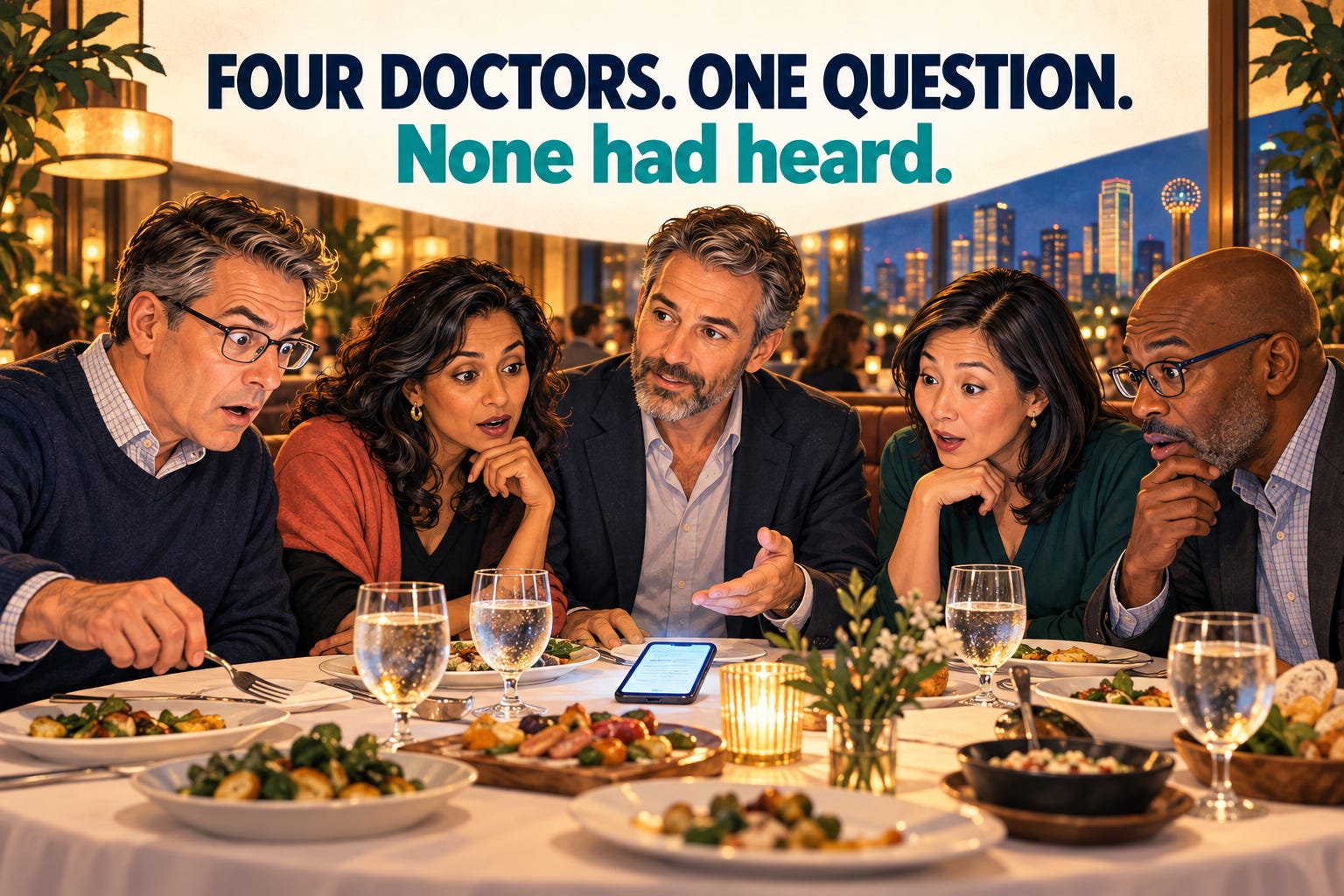
Four physicians at one table, and me. Four for four. Not one had known. (Cartoon representation of the scene, I have nowhere near that much hair and it was actually all guys!)
It isn’t just my friends
I used to think maybe it was just my corner of medicine. It isn’t.
You won’t hear it on the giant health podcasts either. I watched one of the world’s leading autism experts sit for an interview on an enormous show. When the hosts asked him, point blank, what a parent might do to lower the odds, he did not mention prenatal vitamins. Instead, he suggested that trying to reduce the rate of autism at all amounted to eugenics.
The hosts pushed back. They asked why it would be wrong for a parent to want to lower the chance of a condition that carries with it much higher rates of intellectual disability, depression, anxiety. [5, 6] They asked about the parent of a single autistic child, lying awake, wondering who will care for that child after they’re gone. The comments section criticized the expert for his claim that conversations on prevention would be somehow immoral.
The expert didn’t really engage with the questions.
And it’s much bigger than just this one expert, as you’ll see below. Not in a million years could I have expected this stumbling block. Preventing spina bifida through prenatal vitamins is as mainstream and socially acceptable as you can get. But doing the same for autism of your own free will, or even talking about it, somehow makes you an immoral eugenicist? I just can’t close that loop. And I have personally seen with my own eyes how treating the whole subject as untouchable is a large part of why the information never reaches the people who want it most.
Here is a direct quote from Johns Hopkins researchers in a published peer-reviewed paper:
“the results confirm the protective effects of adequate vitamin supplementation for ASD [autism spectrum disorder] risk” [4]
And another quote from mainstream Newsweek magazine in 2024:
“prenatal multivitamins…are…associated with a reduced likelihood of childhood autism diagnoses” [7]
The message is not fringe or crazy. It’s just not spreading.
The machine that called it “maddening”
Which brings me back to that late night at the foot of Luke’s bed.
I spent nine months making short videos about these peer-reviewed studies for a major social media platform. Nothing crazy — a board-certified physician in scrubs, reading straight from published research. The videos got zero views outside of my own family. Not low views. Zero. For months, my family were the only human beings who ever watched them.
I called my mother one afternoon and laughed about it. “Mom,” I told her, “this phone call is getting me more reach than social media. At least I’m reaching one person — you. With the videos, it’s been zero.”
Later, I was using that same social media platform’s AI assistant to help me reframe this very material — hunting for some phrasing that wouldn’t get buried. And at one point the AI told me the truth about itself. It admitted that linking prenatal vitamins to lower autism rates — the two ideas at the very heart of everything I am trying to say — is precisely what trips the automated filters. The AI assistant itself called the situation maddening: that a board-certified physician and a father, looking straight at data that could matter to families, has to walk on eggshells because a cold, automated filter was hypersensitive to the word “autism.” Its word. Maddening.
So there it was, in writing, from the machine itself. The reason this research can’t find an audience isn’t that it’s wrong. It’s that the words autism and lower rate, spoken in the same breath, set off an alarm built for hucksters and liars — and catch the honest by accident. I read it at the foot of my sleeping son’s bed, the dog snoring next to us, and I thought: this is exactly how something that could help stays a secret.
To be clear, I did not receive any strikes on the social media platform. I was not banned. The company’s AI assistant just implied that it would not help me spread the message.
A number that should stop you cold
Here is the part I wish the experts and the social media companies would consider.
We tell every woman of reproductive age to start a prenatal vitamin BEFORE trying to get pregnant. It is old, settled, uncontroversial advice. And yet, in the Boston Birth Cohort — a major study out of Johns Hopkins, more than seven thousand mothers — only 4.3 percent reported starting a consistent prenatal before pregnancy. [8] Fewer than one in twenty.
The recommendation exists. Very few follow it. Or at least very few follow the part about starting the prenatal BEFORE pregnancy, according to this one study.
We ask people to take prenatal vitamins mainly to help prevent spina bifida and other neural tube defects — serious birth defects that affect roughly 1 in 1,000 live births. [9] Now imagine telling people there may be a second reason to bother: a possible association with lower rates of autism, which now affects 1 in 31 children. [6] That means autism is over 30 times more common than neural tube defects. Even as a doctor, I can barely remember the last time I saw spina bifida. But autism? It’s everywhere. I think knowing the prenatal vitamin autism association could change what a person does on an ordinary Tuesday. I think it could move that 4.3 percent much higher.
Getting this information out, and then letting people decide for themselves, is the entire reason I’m writing this.
The ask
The algorithms won’t carry this message — I have a failed social media channel with zero views (except for family) as evidence. Most doctors, even excellent ones, have never heard it. Which leaves exactly one way for this information to travel: the old way. One person telling another.
I’m doing this basically for free. No sponsors, no supplement deals, no ads. I make my living as a doctor taking care of patients. My only ask is the same one I’ll make at the end of nearly every one of these: if this rings true, tell one person. A sister. A friend. A colleague who’s thinking about starting a family. That is how it moves — or it doesn’t move at all.
Next time: the four weeks that decide more than almost anyone realizes — and why “start when the test turns positive” may already be too late.
— Jeff Zadeh, M.D.
General education from one physician’s perspective, not medical advice. The autism-related research described here is observational — association, not proof of cause — and cannot predict any individual child’s outcome. Please make decisions with your own clinician.
References
[1] Surén P, Roth C, Bresnahan M, et al. Association between maternal use of folic acid supplements and risk of autism spectrum disorders in children. JAMA. 2013;309(6):570–577. https://doi.org/10.1001/jama.2012.155925 Norwegian Mother and Child Cohort Study: folic acid use from four weeks before through eight weeks after conception was associated with 39% lower adjusted odds of autistic disorder.
[2] Schmidt RJ, Iosif AM, Guerrero Angel E, Ozonoff S. Association of maternal prenatal vitamin use with risk for autism spectrum disorder recurrence in young siblings. JAMA Psychiatry. 2019;76(4):391–398. https://doi.org/10.1001/jamapsychiatry.2018.3901 MARBLES: prenatal vitamin use during the first month of pregnancy was associated with 50% lower adjusted risk of autism in younger siblings of children with autism.
[3] Schmidt RJ, Tancredi DJ, Ozonoff S, et al. Maternal periconceptional folic acid intake and risk of autism spectrum disorders and developmental delay in the CHARGE (CHildhood Autism Risks from Genetics and Environment) case-control study. Am J Clin Nutr. 2012;96(1):80–89. https://doi.org/10.3945/ajcn.110.004416 CHARGE: at least 600 mcg/day of folic acid from supplements and fortified breakfast cereals in the first month of pregnancy was associated with 38% lower adjusted odds of autism. Studies [1–3] are observational and examine differing exposure windows; they do not all isolate starting prenatal vitamins before pregnancy.
[4] Raghavan R, Riley AW, Volk H, et al. Maternal multivitamin intake, plasma folate and vitamin B12 levels and autism spectrum disorder risk in offspring. Paediatr Perinat Epidemiol. 2018;32(1):100–111. https://doi.org/10.1111/ppe.12414 Boston Birth Cohort; source of the quoted sentence in the Discussion. The bracketed expansion of ASD is added for clarity. This observational study assessed supplementation during pregnancy; its findings do not establish causation.
[5] Kirsch AC, Huebner ARS, Mehta SQ, et al. Association of comorbid mood and anxiety disorders with autism spectrum disorder. JAMA Pediatr. 2020;174(1):63–70. https://doi.org/10.1001/jamapediatrics.2019.4368 Published online December 2, 2019. Supports the statement about co-occurring mood and anxiety disorders, not the podcast account.
[6] Shaw KA, Williams S, Patrick ME, et al. Prevalence and early identification of autism spectrum disorder among children aged 4 and 8 years — Autism and Developmental Disabilities Monitoring Network, 16 sites, United States, 2022. MMWR Surveill Summ. 2025;74(2):1–22. https://doi.org/10.15585/mmwr.ss7402a1 Source of “1 in 31”: eight-year-old children across 16 surveillance sites in 2022, both sexes combined. Also reports co-occurring intellectual disability.
[7] Dewan P. Autism study finds link with pregnancy diet. Newsweek. July 18, 2024. https://www.newsweek.com/autism-pregnancy-diet-link-1927083 News report, not a primary research study. The excerpt uses ellipses to omit other nutritional exposures mentioned in the original sentence.
[8] Cheng TL, Mistry KB, Wang G, Zuckerman B, Wang X. Folate nutrition status in mothers of the Boston Birth Cohort, sample of a US urban low-income population. Am J Public Health. 2018;108(6):799–807. https://doi.org/10.2105/AJPH.2018.304355 Table 2: 325 of 7,612 mothers (4.3%) reported taking prescribed prenatal vitamins almost daily before pregnancy. This figure describes this cohort, not a nationally representative sample.
[9] Duke Molecular Physiology Institute. Neural tube defects (NTDs). Duke University. Accessed October 1, 2026. https://dmpi.duke.edu/neural-tube-defects-ntds Gives an estimate of approximately 1 in 1,000 U.S. live births; the page does not identify the estimate’s study period. The comparison with [6] is approximate: birth prevalence versus autism identified by age eight.