


Season 1 · Episode 4 of 8
For weeks, Luke kept asking me for “black pants with a bowtie.”
I had no idea what he meant. He asked over and over — that’s how Luke is; when something catches him, he circles back to it again and again — and I kept coming up empty. Then one day he pointed at a stranger, triumphant, and I finally saw it: a pair of Under Armour sweatpants. The logo. That was the bowtie. And once he’d shown me, I couldn’t unsee it — it does look a little like a bowtie, or a butterfly, if you actually stop and look. But I never would have stopped to look. Luke sees patterns the rest of us walk straight past. He noticed the day his therapist swapped her contacts for glasses before anyone else in the room said a word.
I’ve come to think of this whole project as a lengthy attempt to do what Luke does without trying: to notice a pattern that had been sitting in plain sight the entire time, that somehow none of us were seeing.
Because I already told you the embarrassing part. I’m a physician, and when it came to my own family, I never looked. I had it filed away that prenatal vitamins were about preventing spina bifida — rare — so why bother. That was the whole of my thinking.
What finally sent me looking wasn’t curiosity. It was desperation. There was a hard irritable stretch when Luke was around five, and we were willing to try almost anything, read anything, drive anywhere. My brother — also a doctor — mentioned a pediatrician near Tampa where my brother had done a mini-internship. On that doctor’s website I found a reference to preconception counseling and autism. The citations were old and out of date. But they cracked a door, and I put my shoulder to it, and I have not stopped since.
What I found on the other side wasn’t fringe. It was JAMA. It was researchers from Johns Hopkins and UC Davis, in studies funded by the NIH. And it began, of all places, with a success story nearly everyone already knows.
The spark
In the early 1990s, a landmark randomized trial showed that folic acid, started before pregnancy, sharply reduced neural tube defects — the serious malformations of the brain and spine.[1] The result was so decisive it rewrote public health. It’s why folic acid is in your cereal and your bread today. One of the great public health accomplishments of the 20th century.
And it left scientists with a question that hasn’t stopped echoing: if folate helps build a healthy brain and spinal cord, what else might it quietly be protecting?
That question launched some of the most ambitious pregnancy studies ever attempted. But there’s a catch that shapes this entire field, and you need to know it before understanding everything that followed.
The trial nobody can run
To prove cause, you’d run that same kind of randomized trial — half the women are randomly assigned to get a real prenatal, half get a placebo — and follow the children for years, counting autism diagnoses.
No ethics board on earth will approve that placebo controlled study. We already know folate prevents neural tube defects. You cannot deliberately hand a pregnant woman a sugar pill instead of a prenatal vitamin that you know would protect her baby. The gold-standard placebo controlled randomized experiment essentially is permanently, ethically off the table.
So what options did the researchers have? The hierarchy of evidence tells you. The strongest forms sit at the top of the pyramid, the weakest at the bottom:
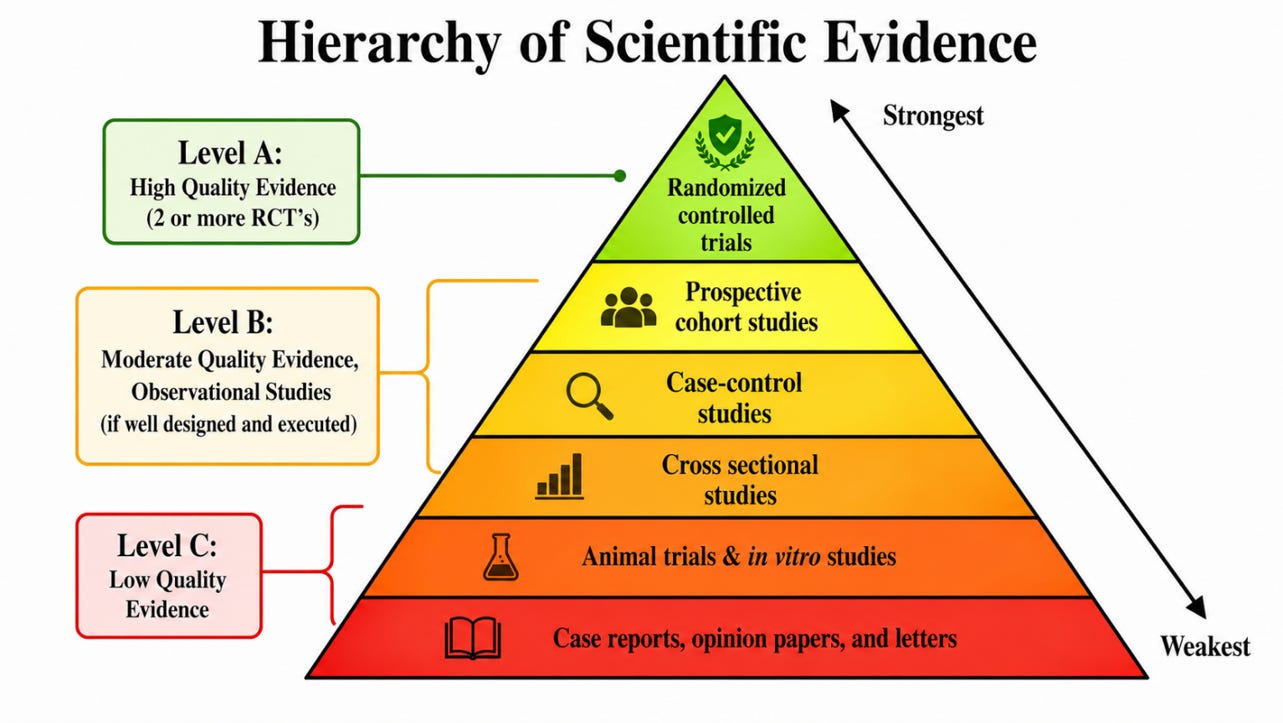
The hierarchy of scientific evidence: randomized controlled trials sit at the top, followed by prospective cohort studies, then case-control studies, case reports, and expert opinion at the bottom. Randomized controlled trials are the gold standard — but for prenatal vitamins and autism, they are essentially permanently off the table. The studies that changed my mind sit one level down: prospective cohort studies, the strongest ethical design available.
The top of the pyramid — randomized controlled trials — is ethically sealed off, at least placebo controlled ones. So look one level down. Prospective cohort studies.
So that’s exactly the kind of study the researchers did, starting in the late 1990s. They enrolled thousands of pregnant women, recorded what they actually took, and followed their children for years. The women decided to take prenatal vitamins, or not, of their own free will so no ethical issues. These studies can’t manufacture proof of cause the way a randomized trial can — but these prospective cohort studies are the strongest ethical design that we can do. They also cost tens of millions of dollars and take the better part of two decades, and because no one can patent a vitamin, corporations are highly unlikely to fund them. What we have is, realistically, what we will ever have. Waiting for a cleaner study is a decision to wait for decades, at best.
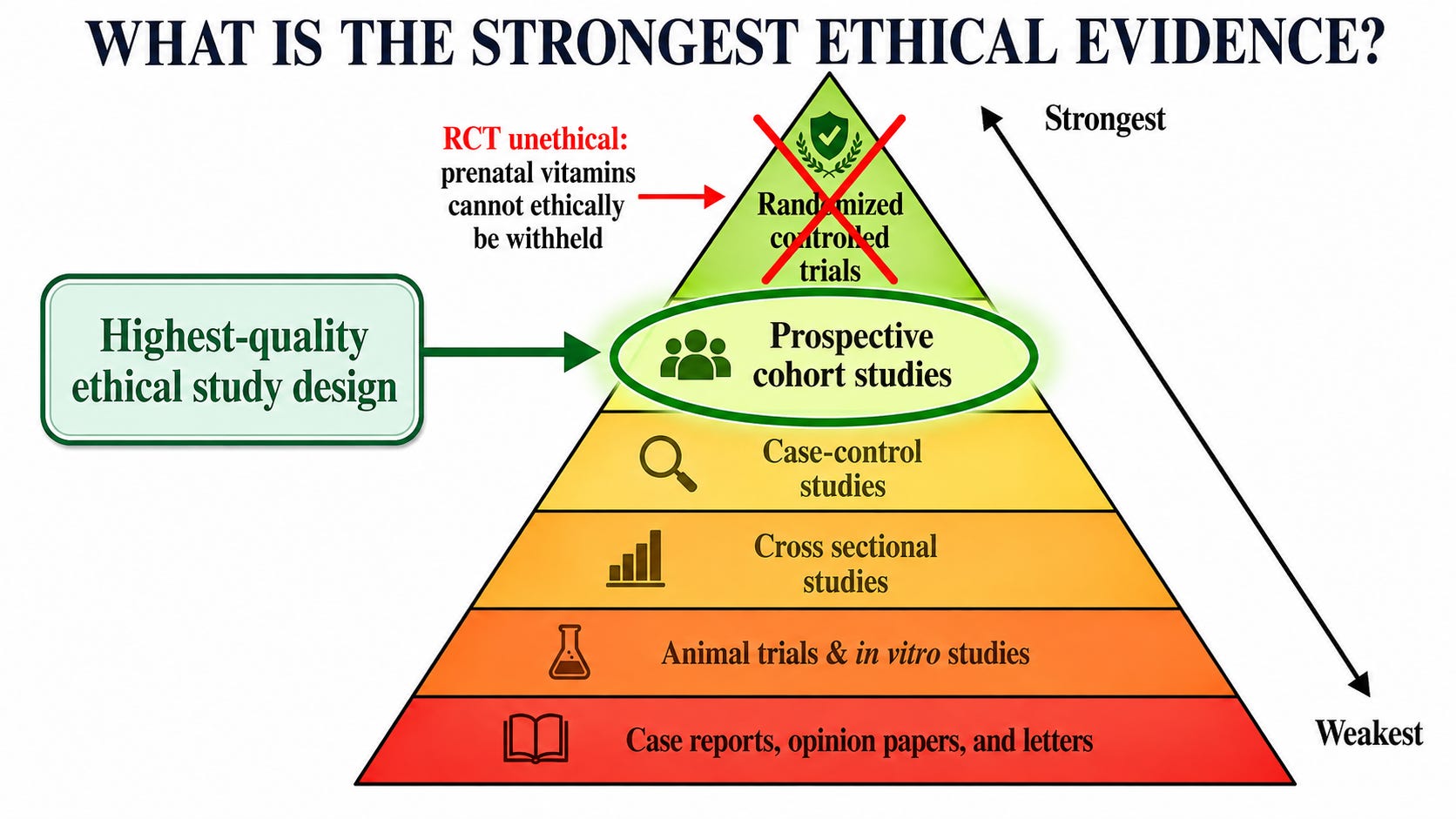
Here are the ones that changed my mind.
CHARGE: two conditions and a fingerprint
The first real signal came out of California — the CHARGE study, from the UC Davis MIND Institute. (The same group, as it happens, behind the iron finding I promised you.)
Mothers who took a prenatal containing at least 600 micrograms of folic acid daily during the first month of pregnancy had children with roughly 38% lower odds of autism.[2] And the more they took in that early window, the lower the odds went — a dose-response, the kind of tidy pattern that makes a researcher lean in.
But two conditions had to be met. The prenatals had to be started early — that first month (counting from Day 1 of the menstrual period before pregnancy). And it had to be enough — at least 600 micrograms folic acid. Miss either, and the association vanished.
Then CHARGE found the thing that turned a correlation into something with a pulse. The protection was strongest in the mothers who carried a common variant in the MTHFR gene — the one that makes the body worse at converting folic acid ultimately into its usable form. The people whose folate machinery worked worst benefited the most from getting plenty of it early.
That’s called a gene-environment interaction, and it’s exactly the fingerprint you’d expect if folate were doing something real — not just tagging along with some other healthy-mother habit. When the people who need a nutrient most are the ones it helps most, that isn’t a coincidence. That’s a clue.
MARBLES: the result that made me put the laptop down
If I could get everyone planning a family to read one study, it would be this one.
MARBLES followed the younger siblings of children with autism — kids at genuinely high risk — from before or early in pregnancy. It tracked whether mothers took a prenatal in that critical first month. Then expert clinicians assessed each child at age three for autism.
These are the families who lie awake over exactly this question. Whether their second child will also have autism. I know. We were one of them.
Among children whose mothers did not take a prenatal in the first month, autism was diagnosed in 32.7%. Among those whose mothers did, it was 14.1%. After adjustment, first-month use was associated with about half the risk.[3] One in three, versus one in seven.
Then two more findings, the kind that rarely make the headline.
When autism did occur, it tended to be milder in the early-prenatal group.
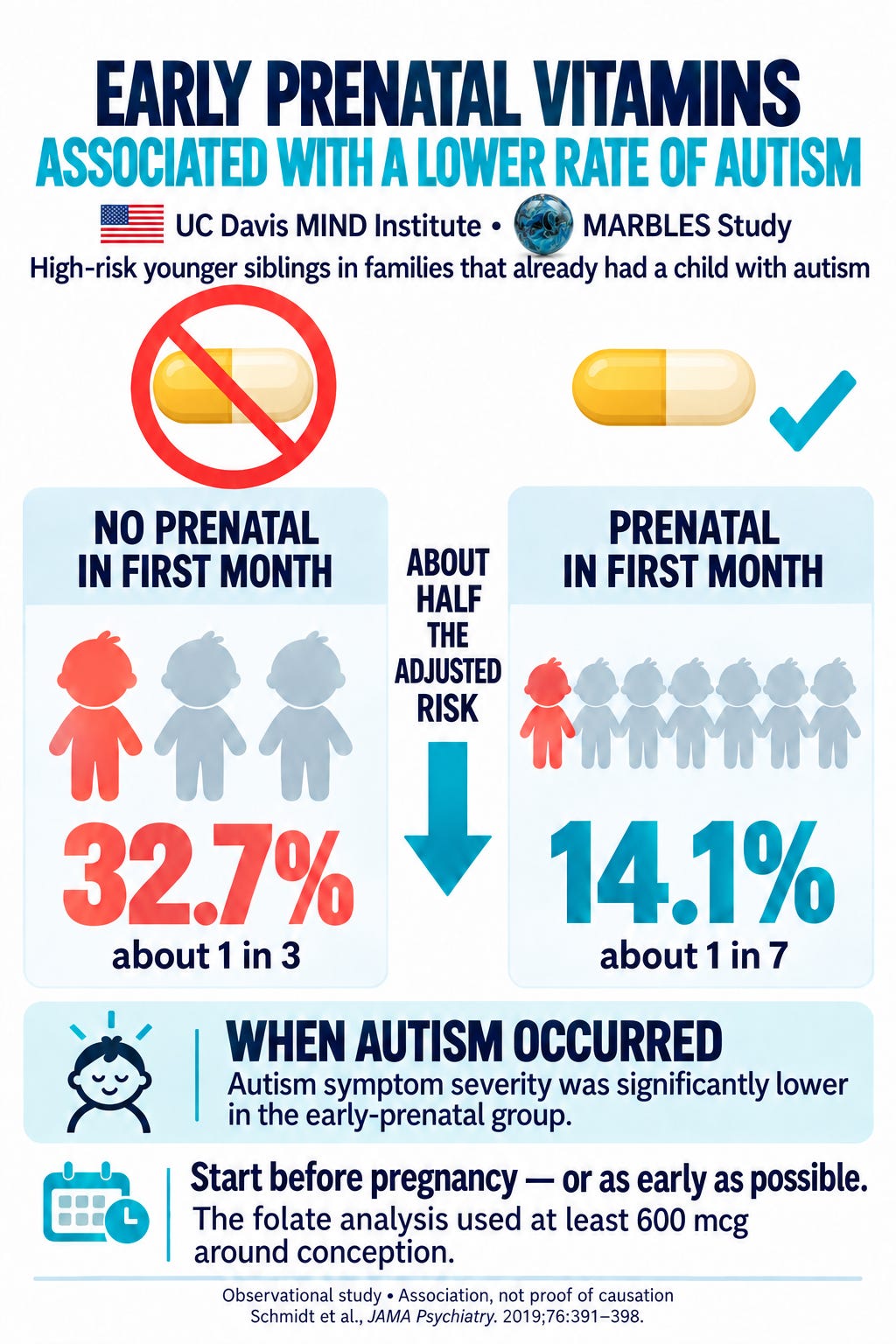
And every child took a standardized cognitive assessment — scored like an IQ test, average 100. The children of mothers who started prenatals early scored about seven points higher — whether or not they ended up with autism. Seven points is nearly half a standard deviation. Across a population, that’s the difference between average and clearly above average. We spend fortunes chasing effects far smaller than that.
Less autism. Milder autism when it came. And a cognitive difference of half a standard deviation — from a vitamin most families already own, taken a few weeks earlier than they’d otherwise start.
That’s the one that made me close the laptop and just sit there for a minute.
And one detail to file away, because it matters more than it looks: the women in MARBLES weren’t taking a bare folic-acid tablet. They were taking prenatal multivitamins — the whole formulation, with B12, vitamin D, iron, and the rest. Hold onto that. When we reach the detective work, the question of whether it’s the folate alone — or the complete pill doing part of the work — turns out to be one of the most important threads in the story.
MoBa: 85,000 Norwegians
When a finding turns up in a small study, you note it. When it turns up in 85,000 children, you sit up straight.
The Norwegian Mother and Child Cohort Study — MoBa — is enormous, meticulous, and prospective: women enrolled during pregnancy, supplement use recorded in real time, nobody relying on memory. Children of mothers who used folic acid around conception had a lower rate of autistic disorder — about 0.10% versus 0.21%, roughly 40% lower with adjustments for covariates.[4] A different country. A different health system. Pointing the same direction.
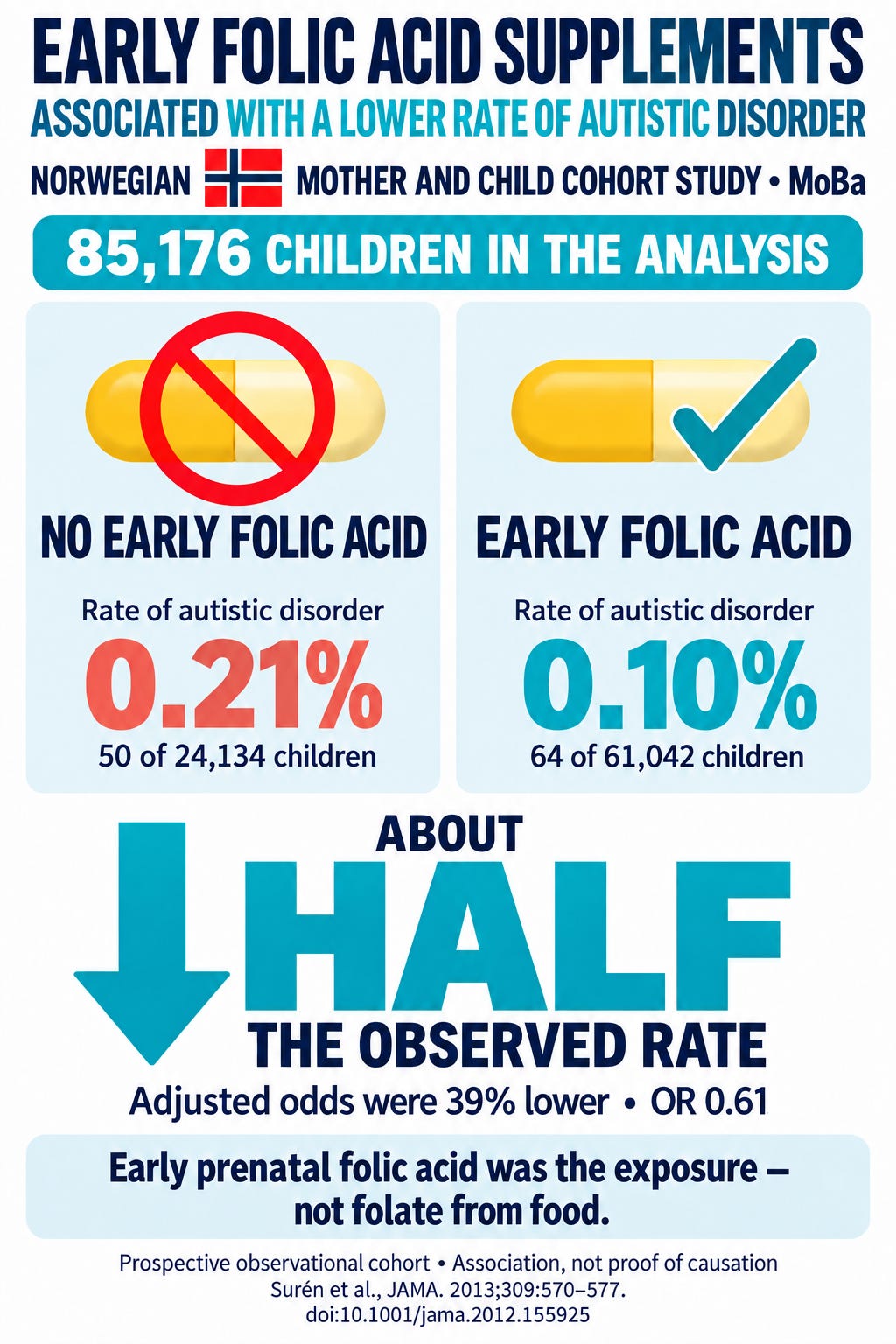
Boston: the word “enough”
Every study so far pointed one way — more folate, less autism. One taught me to respect the word enough. The Boston Birth Cohort found the lowest autism risk not at the highest supplement use, but in the middle, with risk creeping back up at both ends — too little and too much.[5] The target is adequacy, not maximum, meaning no mega dosing. I’ll give that finding its own post, because it changes how you should read the very word “dose.” For now, just hold the shape: a valley, not a slope.
Step back
Four studies. A California case-control study with a gene-level fingerprint. A prospective study of high-risk siblings showing half the risk. A national cohort of 85,000. An urban cohort teaching moderation. Different tools, different countries, different teams — all pointing the same way. That is about as much as observational science can offer, short of a randomized trial that can never ethically be run.
So let me bring you back to the number that made me stop. In the families often most afraid of it — the ones who already had one autistic child — first-month prenatal use tracked with one in seven instead of one in three. Half the risk. From a ten-dollar bottle, started a few weeks sooner than most do.
Which raises the obvious question. If the evidence is this consistent, why isn’t it printed on every pregnancy pamphlet in America?
Because it doesn’t look consistent — not at first. There are a few studies, from Denmark and Japan, that seemed to demolish the whole idea. No association at all. For a decade, that apparent contradiction is what killed the momentum and let everyone move on.
And when I finally stopped trusting the summaries and dug into those “negative” studies myself — into the methods sections, the footnotes, the supplementary tables nobody reads — I found something hiding in plain sight. One detail. One number. And it makes every study in this field, the positive and the negative alike, suddenly seem to agree.
That’s where this turns into a detective story.
Next time: how Scandinavia “disproved” it — with the wrong dose.
— Jeff Zadeh, M.D.
General education from one physician’s perspective, not medical advice. Every study named here is observational — association, not proof of cause — and cannot predict any individual child’s outcome. Please make decisions with your own clinician.
References
[1] MRC Vitamin Study Research Group. Prevention of neural tube defects: results of the Medical Research Council Vitamin Study. Lancet. 1991;338(8760):131–137. And Czeizel AE, Dudás I. Prevention of the first occurrence of neural-tube defects by periconceptional vitamin supplementation. N Engl J Med. 1992;327(26):1832–1835.
[2] Schmidt RJ, Tancredi DJ, Ozonoff S, Hansen RL, Hartiala J, Allayee H, Schmidt LC, Tassone F, Hertz-Picciotto I. Maternal periconceptional folic acid intake and risk of autism spectrum disorders and developmental delay in the CHARGE (CHildhood Autism Risks from Genetics and Environment) case-control study. Am J Clin Nutr. 2012;96(1):80–89. (Adjusted OR 0.62 for mean daily folic acid intake of at least 600 mcg in the first month; the association was strongest for mothers and children carrying MTHFR 677 C>T variant genotypes.) See also Schmidt RJ, Hansen RL, Hartiala J, et al. Prenatal vitamins, one-carbon metabolism gene variants, and risk for autism. Epidemiology. 2011;22(4):476–485. (Prenatal vitamin use in the three months before pregnancy or the first month; OR 0.62, 95% CI 0.42–0.93.)
[3] Schmidt RJ, Iosif AM, Guerrero Angel E, Ozonoff S. Association of maternal prenatal vitamin use with risk for autism spectrum disorder recurrence in young siblings. JAMA Psychiatry. 2019;76(4):391–398. (Adjusted relative risk 0.50, 95% CI 0.30–0.81; autism in 14.1% of children whose mothers took a prenatal in the first month versus 32.7% of those who did not; adjusted mean difference of 7.1 points on the Mullen Scales of Early Learning.)
[4] Surén P, Roth C, Bresnahan M, Haugen M, Hornig M, Hirtz D, Lie KK, Lipkin WI, Magnus P, Reichborn-Kjennerud T, Schjolberg S, Davey Smith G, Oyen AS, Susser E, Stoltenberg C. Association between maternal use of folic acid supplements and risk of autism spectrum disorders in children. JAMA. 2013;309(6):570–577. (85,176 children; autistic disorder in 0.10% of folic acid users versus 0.21% of non-users; adjusted OR 0.61, 95% CI 0.41–0.90.)
[5] Raghavan R, Riley AW, Volk H, et al. Maternal multivitamin intake, plasma folate and vitamin B12 levels and autism spectrum disorder risk in offspring. Paediatr Perinat Epidemiol. 2018;32(1):100–111.