


Season 1 · Episode 8 of 8
For a long time, I didn’t want children at all.
I was really lucky. As an adult I got to travel, carefree and often — a physician’s income, plentiful and flexible ER shifts, no serious obligations. Hiking through Icelandic waterfalls, climbing the Eiffel Tower, cycling around the Big Island in Hawaii. The stuff of dreams.
Then one day it hit me: I wanted kids. Because when I looked back on a full year of travel, the best part hadn’t been any exotic destination. It was being with my parents, my brothers, their families — at the small cottage my grandfather built overlooking a lake up north in Michigan. Preparing meals together. Talking over dinner. Little day trips with the nephews. The closeness of it beat every skyline I’d flown to see.
As a physician, I sit with people near the end of their lives, and I’ve watched the same thing over and over: the more loved ones a person has, and the closer they are to those loved ones, the happier and more connected they are at the end. When my own first child arrived, it was the closest connection I had ever felt.
Then it got hard
Our first two kids came quickly — born 20 months apart. After that, it was a struggle. We tried everything. And every negative test felt like the worst rejection I have ever experienced — much worse than rejection for a job, or a medical school admission, or a high school dance. I felt like a failure. And that’s when we already had two kids but just wanted more. I cannot imagine what it must feel like for people trying to have their first.
In the lowest stretch, I read something I’ve never forgotten. I think it was a post online, buried somewhere, written by a woman who’d struggled far longer than we had — years longer. And what she wrote reached down and lifted me clean off the floor.
She said: if you truly want a baby, you will have your baby. It may not come the way you pictured. There are many roads to a family — IVF, adoption, surrogacy, paths you haven’t even imagined yet. But when you want something deeply enough, and it’s a noble cause, the world has a way of conspiring to help you make it happen. A complete stranger gave me hope.
Eventually, we gave up. Completely.
And then we had our third child, seemingly out of nowhere. And then another. Our youngest is four now. All four of our kids are so full of energy and spunk, almost too much of it. Three are typically developing. One is our wonderful Luke.
What I’d gently pass along
I won’t pretend a checklist fixes infertility; it doesn’t, and if you’re in the thick of it right now, I’ve been there too — I hope this story helps, even in some small way. But a few practical things are worth knowing, so I’ll keep them brief:
• Stop drinking alcohol while you’re trying — not “cut back,” stop. You can be pregnant for weeks before you know it, and there’s no established safe amount in those earliest days. [1]
• Consider an ovulation predictor kit. Of everything on this list, this is the one with the best evidence for actually shortening the time it takes an otherwise healthy couple to conceive. It reads the hormone surge that flags your most fertile days — and, as much as anything, it gently nudges two busy, tired people to make the time when it counts. [2]
• For the men, briefly: since sperm take roughly 2 to 3 months to mature, the ideal window to ease off hot tubs, saunas, alcohol, and smoking is the three months before trying. And start moving toward a healthier weight — you don’t need to look like an Olympian, just begin. Even a walk when you can is a real start.
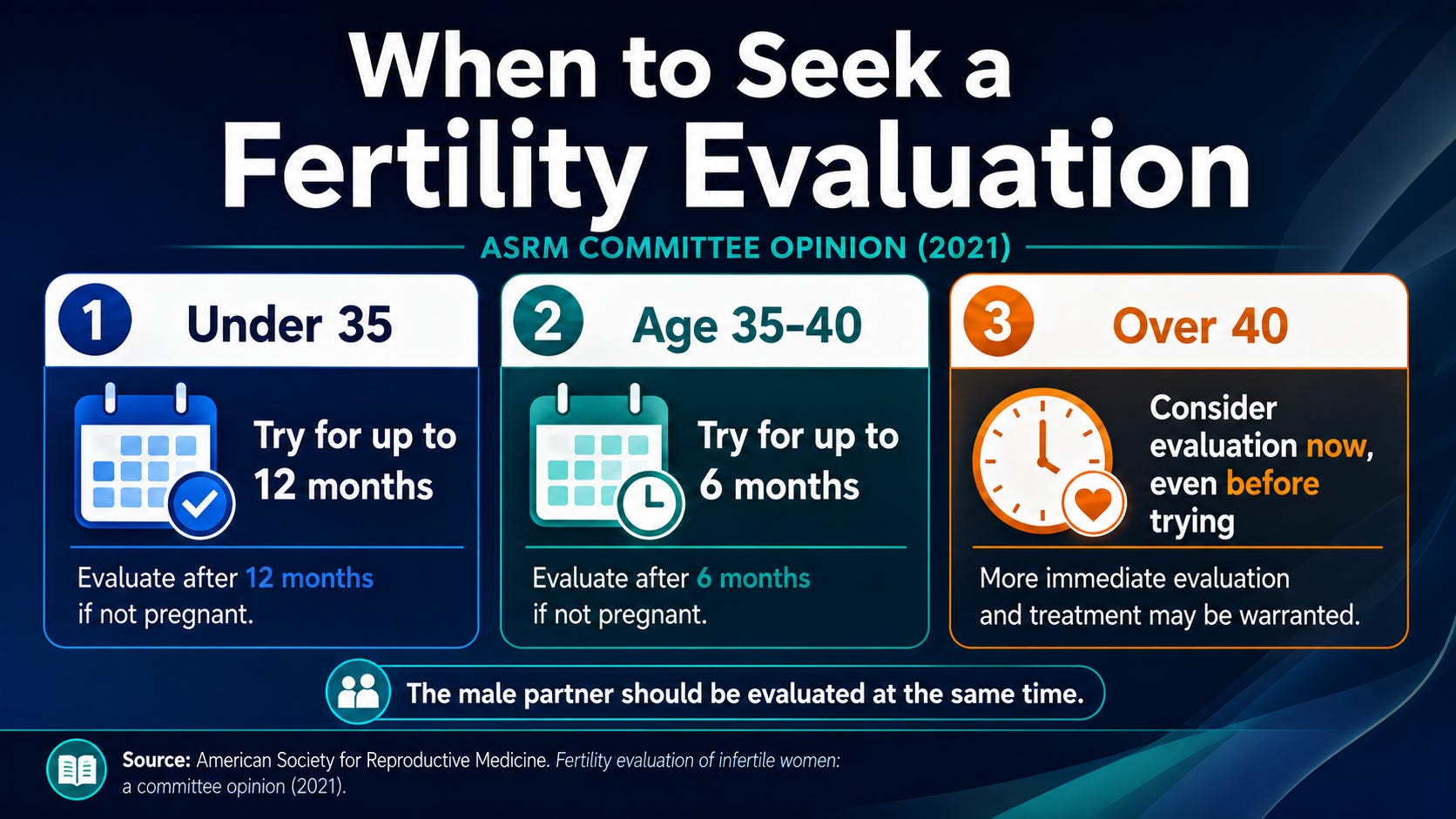
• Watch the clock, kindly. Under 35, it’s standard to see a fertility specialist after about a year of trying; from 35 to 40, after six months. Over 40, it’s entirely reasonable to go straight to a specialist before your first attempt. And at any age, see your OB/GYN early if your periods are irregular or absent. [3]
• A Mediterranean-style diet is last on this list on purpose — the fertility evidence is limited. But it’s good for you either way, so it stays.
Home
Here’s where I’ve landed.
Even on the worst days — when I’ve lost count of how many nights in a row a kid has woken me up, when the dogs steal a dinner off the counter that took me two hours to make, when Luke tears down another towel rack playing Tarzan — even then, I don’t have the slightest shred of doubt about where I am.
I am exactly where I’m supposed to be. Home. With my family.
Season 2 begins soon, and the investigation resumes — Japan, China, and the moment the dose clue finally cracked the whole case open. But I wanted to stop here first, at the cottage on the lake, and tell you the part that matters more than any study: it can happen. Sometimes it happens right after you’ve stopped believing it will.
— Jeff Zadeh, M.D.
General education from one physician’s perspective, not medical advice. Please make decisions with your own clinician.
References
[1] Alcohol before and during pregnancy
Centers for Disease Control and Prevention. About Alcohol Use During Pregnancy. Accessed September 30, 2026. https://www.cdc.gov/alcohol-pregnancy/about/index.html
American College of Obstetricians and Gynecologists. Alcohol and Women. Accessed September 30, 2026. https://www.acog.org/womens-health/faqs/alcohol-and-women
Both organizations advise avoiding alcohol when pregnant or trying to conceive. This recommendation protects against prenatal alcohol exposure; it is distinct from the question of whether moderate drinking reduces the chance of conception.
Mikkelsen EM, Riis AH, Wise LA, Hatch EE, Rothman KJ, Cueto HT, Sørensen HT. Alcohol consumption and fecundability: prospective Danish cohort study. BMJ. 2016;354:i4262. https://doi.org/10.1136/bmj.i4262
In this prospective cohort, consumption below 14 servings per week was not associated with a discernible reduction in fecundability. This finding does not establish the safety of alcohol during pregnancy.
[2] Ovulation testing and pregnancy outcomes
Johnson S, Stanford JB, Warren G, Bond S, Bench-Capon S, Zinaman MJ. Increased likelihood of pregnancy using an app-connected ovulation test system: a randomized controlled trial. J Womens Health (Larchmt). 2020;29(1):84–90. https://doi.org/10.1089/jwh.2019.7850
In a study involving 844 women aged 18–40, the reported first-cycle pregnancy rate was 25.4% with the test system versus 14.7% without ovulation testing (p<0.001); the analysis excluded participants without evaluable data. The system measured both urinary LH and an estrogen metabolite. The trial was manufacturer-funded, and several authors were manufacturer employees.
Johnson S, Bond S, Grace B, Marriott L. Increased chance of live birth following use of connected ovulation test system: outcome results from a randomized controlled trial. Womens Health Rep (New Rochelle). 2022;3(1):60–66. https://doi.org/10.1089/whr.2021.0102
Follow-up of the same trial found live births resulting from first-cycle conceptions in 16.4% of the test group versus 8.5% of controls (OR 2.12, 95% CI 1.34–3.35), excluding participants lost to follow-up. This was not a separate trial.
Gibbons T, Reavey J, Georgiou EX, Becker CM. Timed intercourse for couples trying to conceive. Cochrane Database Syst Rev. 2023;9:CD011345. https://doi.org/10.1002/14651858.CD011345.pub3
The review concluded that urinary ovulation testing probably increases pregnancy and live-birth rates in women under 40 who have been trying for less than 12 months. Evidence was insufficient to determine its effect on time to pregnancy as a separate outcome; many included trials were manufacturer-funded.
[3] When to seek a fertility evaluation
Practice Committee of the American Society for Reproductive Medicine. Fertility evaluation of infertile women: a committee opinion. Fertil Steril. 2021;116(5):1255–1265. https://doi.org/10.1016/j.fertnstert.2021.08.038
ASRM recommends evaluation after 12 months of trying in women under 35 and after six months at age 35 or older. More immediate evaluation may be warranted over age 40. Evaluation should begin without delay when a condition associated with infertility is present, including irregular or absent periods.