


Season 1 · Episode 3 of 8
Luke loves candy. If he had his way, his entire food pyramid would be built by stacking different kinds of candy on top of each other.
A few weeks before Christmas, he discovered that Christmas meant sugar — lots of it — and he could not let it go. When Luke gets excited about something, he brings it up again and again and again, the same sentence, the same delight, on a loop. I’m going to get sugar on Christmas.
So one evening we sat down with him and did the only thing that ever really helps: we made it visible. We drew a calendar together, and every night before bed he crossed off another box, counting down the days until the morning he was promised his sugar. The waiting got easier the moment he could see the clock running.
I think about that calendar, because pregnancy has a countdown too. But it’s invisible at the start.
A four-week construction project laying the foundation
Here are some facts that changed how I think about early pregnancy.
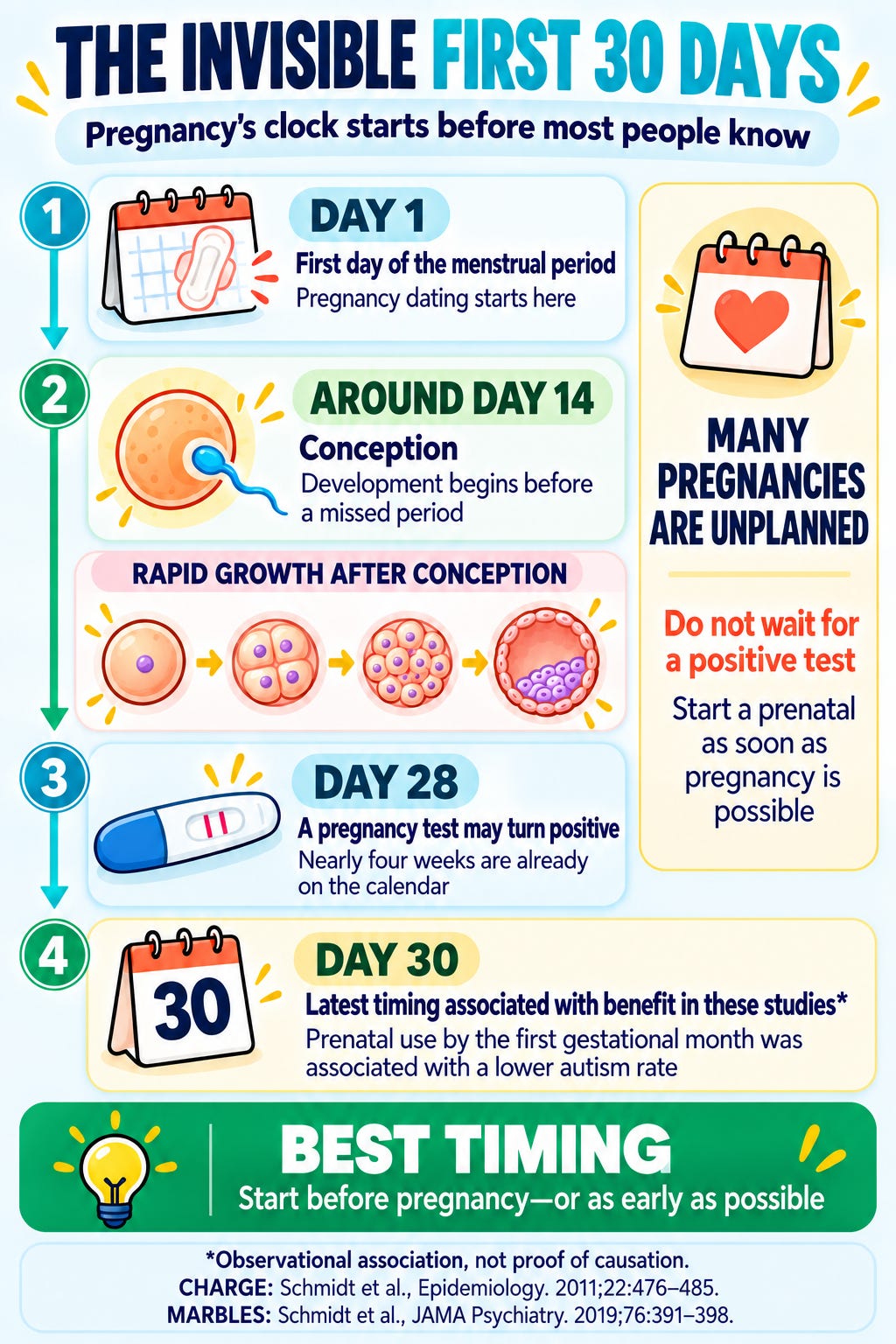
Pregnancy is actually dated from Day 1 of the menstrual period before pregnancy — a convention that places conception around Day 14, as strange as that may seem. From conception, development moves astonishingly fast. Within days, a cluster of cells implants and begins laying down the body’s basic blueprint. By around the third to fourth week after conception, a structure called the neural tube — the precursor to the entire brain and spinal cord — folds over and seals shut. The heart begins to beat. The first faint scaffolding of eyes, limbs, and organs is sketched in.[1]
By the time a home pregnancy test reliably reads positive, you are already about halfway from conception to the moment the neural tube seals shut.
The single most important nutrient for neural tube closure is folate (vitamin B9). And that window is already half gone by the time a missed period sends someone to the drugstore. The most critical construction on the entire project, the foundation, is often practically done before the owner even knows the site is active.
This is not a reason to panic. It’s a reason to be ready.
Think of it like a building crew. If there isn’t enough concrete on site the morning they pour the foundation, you can’t deliver it three weeks later and pretend it was always there. After the flooring gets put down and the walls start going up, it’s too late to add the missing concrete to the foundation. Folate has to be present as the neural tube forms, not delivered afterward. You can’t backfill the foundation.
There’s a second reason “start now” beats “start soon.” Folate levels inside your red blood cells don’t jump the day you swallow the first pill; they climb gradually over a period of weeks before leveling off.[2] Starting a prenatal the day you see two pink lines doesn’t give your body a running start. Starting at least a month earlier does.
Half of pregnancies don’t send a calendar invite
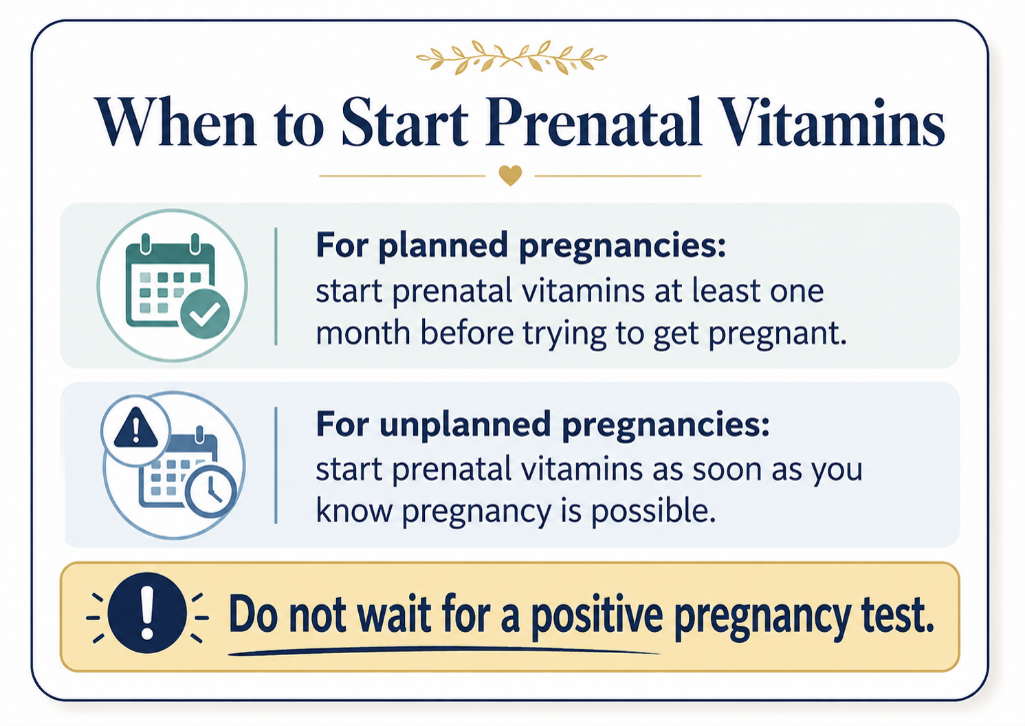
About half of all pregnancies are unplanned.[3] Maybe you have a whirlwind romance and you’re off to Vegas to marry after your first weekend together. In that case, where pregnancy is unplanned, then start prenatals within a day or so of when you know pregnancy is even just a possibility. Don’t wait for a positive pregnancy test. Those home pregnancy tests can take up to two weeks after conception to turn positive. Earlier always beats later. There is no version of this where waiting wins. The first few days and weeks following conception are critical. Starting before pregnancy, or as early as possible, is the single highest-value move in this entire newsletter, and it costs as little as ten dollars a month.
Extensive research supports this recommendation. For the landmark studies showing a reduced rate of spina bifida, the folate was always started before pregnancy.[4]
For autism, prenatal vitamins were associated with a lower rate only if they were started by the first gestational month of pregnancy (based on the CHARGE and MARBLES studies).[5] And remember, that first month counts from Day 1 of the menstrual period. In other words, the prenatals had to be started by about two weeks after conception at the latest. If you wait for a missed period or a positive pregnancy test then it may be too late.
These seminal studies are why every line of my checklist begins the same way: before. Not because I’m anxious. Because the calendar is already counting down, even when you can’t yet see it. This is the step I missed for my own family, so I’m not judging, just encouraging.
And I should offer some reassurance here. These conditions, spina bifida and autism, are relatively uncommon so don’t panic if you start the prenatal late on this pregnancy. The US rate is about 1 in 1,000 for neural tube defects like spina bifida[6] and 1 in 31 for autism. So if you’re late this time, maybe just think about starting prenatals before the next pregnancy. Or pass the message on to a loved one who is planning to start a family.
And of course, it’s still important to start the prenatal even if it’s late, past the first month. New evidence continues to emerge. For instance, prenatals may help reduce the incidence of low birth weight, even if started as late as week 16 of the pregnancy.[7,8]
How to actually choose one
Stand in the prenatal aisle for five minutes and you’ll understand the problem. Twenty bottles, all promising the same things, six dollars to sixty. Most of the front label is marketing. Here’s what actually matters.
Folate — enough of it, and I lean toward methylfolate. Aim for at least 600 micrograms. Both folic acid and methylfolate are believed to work, and a folic-acid prenatal is far better than none. But I lean toward methylfolate (also listed as L-methylfolate, 5-MTHF, or methyltetrahydrofolate on the label). It’s the already-active form — your body can use it directly, no conversion required. A common gene variant called MTHFR makes that conversion sluggish in a meaningful share of people, and methylfolate sidesteps the problem entirely. In addition, one study showed higher levels of unmetabolized folic acid in cord blood were associated with a higher rate of autism, while higher levels of methylfolate were not.[9] A recent randomized trial adds to the case: a prenatal built on methylfolate produced lower unmetabolized folic acid in both maternal and placental tissue than a folic-acid prenatal, while maintaining equivalent total folate levels.[10] About a third of prescription prenatals now use the methylfolate option.[11]
And here is a detail you may want to file away, because it becomes the key to this entire investigation later: two of the landmark studies that tied prenatal vitamins to lower autism rates specified 600 micrograms or more of synthetic folate — from a pill, not from food. That is deeply counterintuitive. You’d assume natural folate from spinach and legumes would absorb better than the manufactured version. It doesn’t. Synthetic folate absorbs far more reliably; folate from food is unpredictable and degrades with heat, light, and time — leave a salad out at room temperature and its folate quietly drains away. Remember: at least 600 micrograms, synthetic, from a supplement. In the USA, 600 mcg of synthetic methylfolate or folic acid will be labeled as roughly 1,000 mcg DFE (dietary folate equivalents).[12] Here is an example of how it will look on the label:
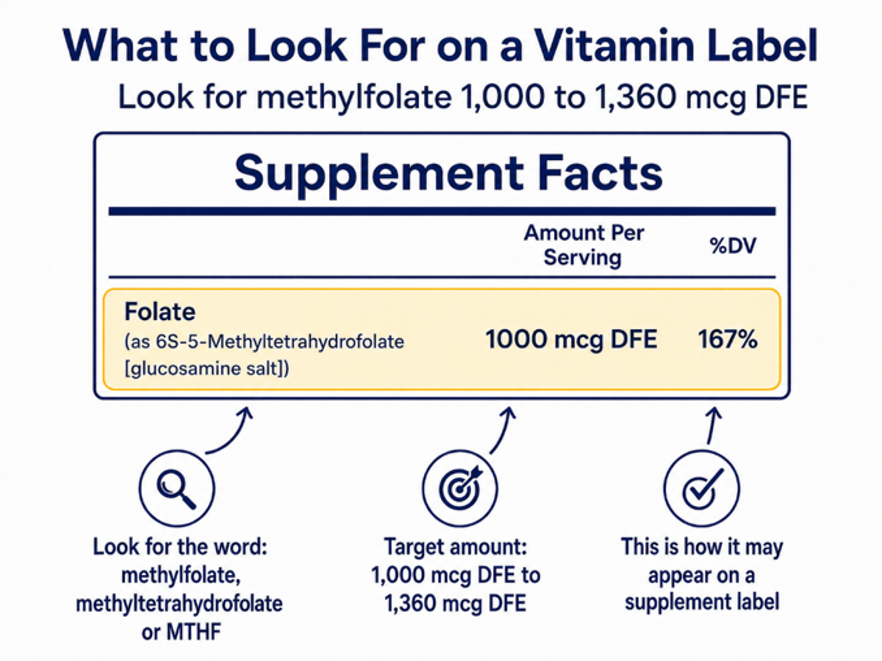
Supplement Facts panel showing folate listed in mcg DFE, with the form of folate given in parentheses.
When we get to the detective work, that 600 mcg threshold (which equals about 1,000 mcg DFE) may make a decade of “contradictory” studies suddenly seem consistent. And of course, the 600 mcg is not a strict threshold, probably more of a gradient, but 600 was the cutoff noted in two major observational studies.
And a warning that follows directly from it. I already knew American prenatals had historically carried at least 600 mcg folate in the early 2000s, because the two studies that looked at intake most directly — CHARGE and MARBLES — found that nearly all the mothers who took a prenatal were getting at least 600 micrograms.[13] But folate content has shifted since then, and many newer prenatals are formulated with considerably less. So don’t assume the bottle in front of you matches the ones in the research. Find the actual amount — at least 600 micrograms of folate, which reads as about 1,000 mcg DFE on the label — if you want to make sure your prenatal reaches that threshold.
Iron — and don’t skip the lab that goes with it. Iron deficiency is extraordinarily common in women of reproductive age and routinely missed. The gentler form is iron bisglycinate (chelated), easier on the stomach. But the real move is a simple blood test before pregnancy: ask for a ferritin level, which measures iron stores and can be low even when a standard blood count looks perfectly normal. A common guideline goal is at least 30 ng/mL.[14] If your ferritin stays below 30 despite oral iron then IV iron may be an option. And I’ll tell you now — folate isn’t the only nutrient with a startling autism signal in these studies. There’s an iron finding out of the same California research group that genuinely stopped me when I read it. I’m going to give iron its own post, because it deserves one.
Don’t forget choline, iodine, and DHA. Choline is vital for brain development and frequently under-dosed in prenatals — cover the gap with eggs or a small separate supplement. Look for iodine (around 150 mcg) and DHA for brain and eye development.
Insist on third-party testing. Heavy metals can turn up in supplements. Look for USP, NSF, Clean Label Project verification or cGMP compliant manufacturing facilities with other independent third party testing. And remember the theme that runs through everything I’ll show you: more is not better. A sensibly dosed, tested prenatal started early beats an expensive megadose started late.
Two examples of prenatals that meet these criteria:
1. Ritual Essential Prenatal Multivitamin for Women
2. Prenatal Pro by Designs for Health
I give these two options so you can have actionable concrete examples, instead of just a 30,000 foot overview. I do not have any financial relationship with any supplement company. I make my living by taking care of patients as a doctor.
The close second: a preconception visit
If I can talk you into one more thing, it’s a short visit with a clinician a few months before you try. Review your medications, update vaccines, get any chronic condition — thyroid, blood pressure — well controlled before pregnancy, and check those labs, especially ferritin and a thyroid test (TSH). It’s the appointment almost nobody books but everybody should.
But notice the ranking. The prenatal comes first. It’s the move with the tightest link to that unforgiving early window, and it’s the one thing you control completely, on your own, starting today. You don’t need permission. You don’t need an appointment. Be aware of that invisible calendar that starts counting down before you know it’s there.
Next time: the studies that changed my mind. I’ll walk you through the research almost no one talks about — and the single result that made me set my laptop down.
— Jeff Zadeh, M.D.
General education from one physician’s perspective, not medical advice, and not a sponsored endorsement of any product. The author has no financial relationship with any supplement company. The autism-related research described here is observational — association, not proof of cause — and cannot predict any individual child’s outcome. Supplement formulations change; verify the current label. Please make decisions with your own clinician.
References
[1] Crider KS, Qi YP, Yeung LF, Mai CT, Head Zauche L, Wang A, Daniels K, Williams JL. Folic acid and the prevention of birth defects: 30 years of opportunity and controversies. Annu Rev Nutr. 2022;42:423–452. doi:10.1146/annurev-nutr-043020-091647. Neural tube formation is complete by approximately 28 days after conception, about 6 weeks from the last menstrual period. Free full text
[2] Obeid R, Schön C, Wilhelm M, Shrestha RP, Pilz S, Pietrzik K. Response of red blood cell folate to supplementation in nonpregnant women is predictable: a proposal for personalized supplementation. Mol Nutr Food Res. 2018;62(4):1700537. doi:10.1002/mnfr.201700537. Red-cell folate rises over weeks to months; the response depends on baseline status, dose, and duration. Free full text
[3] Finer LB, Zolna MR. Declines in unintended pregnancy in the United States, 2008–2011. N Engl J Med. 2016;374(9):843–852. doi:10.1056/NEJMsa1506575. The 45% estimate refers to US pregnancies in 2011. For comparison, CDC reports 41.6% in 2019. Study abstract; CDC updated estimate
[4] MRC Vitamin Study Research Group. Prevention of neural tube defects: results of the Medical Research Council Vitamin Study. Lancet. 1991;338(8760):131–137. doi:10.1016/0140-6736(91)90133-A. Czeizel AE, Dudás I. Prevention of the first occurrence of neural-tube defects by periconceptional vitamin supplementation. N Engl J Med. 1992;327(26):1832–1835. doi:10.1056/NEJM199212243272602. Both randomized trials began supplementation before conception. MRC abstract; Czeizel–Dudás abstract
[5] Schmidt RJ, Hansen RL, Hartiala J, Allayee H, Schmidt LC, Tancredi DJ, Tassone F, Hertz-Picciotto I. Prenatal vitamins, one-carbon metabolism gene variants, and risk for autism. Epidemiology. 2011;22(4):476–485. doi:10.1097/EDE.0b013e31821d0e30. Schmidt RJ, Tancredi DJ, Ozonoff S, et al. Maternal periconceptional folic acid intake and risk of autism spectrum disorders and developmental delay in the CHARGE (CHildhood Autism Risks from Genetics and Environment) case-control study. Am J Clin Nutr. 2012;96(1):80–89. doi:10.3945/ajcn.110.004416. Schmidt RJ, Iosif AM, Guerrero Angel E, Ozonoff S. Association of maternal prenatal vitamin use with risk for autism spectrum disorder recurrence in young siblings. JAMA Psychiatry. 2019;76(4):391–398. doi:10.1001/jamapsychiatry.2018.3901. CHARGE 2011 full text; CHARGE 2012 full text; MARBLES full text
[6] Duke Molecular Physiology Institute. Neural tube defects (NTDs). Duke University. Accessed October 4, 2026. This page estimates that neural tube defects occur in approximately 1 in 1,000 US live births; it does not specify a surveillance year. Duke source
[7] Keats EC, Haider BA, Tam E, Bhutta ZA. Multiple-micronutrient supplementation for women during pregnancy. Cochrane Database Syst Rev. 2019;3:CD004905. doi:10.1002/14651858.CD004905.pub6. Across 18 randomized trials involving 68,801 women, multiple-micronutrient supplements containing iron and folic acid reduced low birth weight by 12% compared with iron with or without folic acid (RR 0.88; 95% CI, 0.85–0.91). Cochrane rated this high-quality evidence. The trials were predominantly conducted in low- and middle-income countries. Free summary and results
[8] Osrin D, Vaidya A, Shrestha Y, Baniya RB, Manandhar DS, Adhikari RK, Filteau S, Tomkins A, Costello AM. Effects of antenatal multiple micronutrient supplementation on birthweight and gestational duration in Nepal: double-blind, randomised controlled trial. Lancet. 2005;365(9463):955–962. doi:10.1016/S0140-6736(05)71084-9. In 1,200 women, supplementation began at 12–20 weeks of gestation (average approximately 16 weeks). A supplement containing 15 vitamins and minerals reduced low birth weight by 25% relative to iron–folic acid supplementation. Study abstract; Free follow-up confirming timing and birthweight findings
[9] Raghavan R, Selhub J, Paul L, et al. A prospective birth cohort study on cord blood folate subtypes and risk of autism spectrum disorder. Am J Clin Nutr. 2020;112(5):1304–1317. doi:10.1093/ajcn/nqaa208. This observational analysis included 567 children, 92 with ASD. It measured cord-blood folate subtypes; it did not compare methylfolate supplements with folic-acid supplements. Free full text
[10] Draicchio F, Hausser J, Sharafi M, Grier-Welch A, Vance A, Alamdari N, Futterman ID, Chudnoff S, Malysheva O, Caudill MA, Hanson I, Jiang X. Using 6S-5-methyltetrahydrofolate instead of folic acid in prenatal multivitamin reduces unmetabolized folic acid concentrations in the mother-fetus dyad: a 24-week randomized controlled trial. Front Nutr. 2026;13:1679067. doi:10.3389/fnut.2026.1679067. Funded by Ritual; four authors were Ritual employees. Supplementation began at 12–16 weeks’ gestation; the trial assessed biomarkers and did not establish prevention of autism or neural tube defects. See also: Cochrane KM, Elango R, Devlin AM, Mayer C, Hutcheon JA, Karakochuk CD. Supplementation with (6S)-5-methyltetrahydrofolic acid appears as effective as folic acid in maintaining maternal folate status while reducing unmetabolised folic acid in maternal plasma: a randomised trial of pregnant women in Canada. Br J Nutr. 2024;131(1):92–102. doi:10.1017/S0007114523001733. Draicchio full text; Cochrane study
[11] Saldanha LG, Dwyer JT, Haggans CJ, Mills JL, Potischman N. Perspective: time to resolve confusion on folate amounts, units, and forms in prenatal supplements. Adv Nutr. 2020;11(4):753–759. doi:10.1093/advances/nmaa017. In the historical label sample, 32% of prescription and 25% of nonprescription prenatal products contained salts of L-5-MTHF. These percentages are not a current market estimate. Official neural-tube-defect prevention recommendations specify folic acid. Free full text
[12] US Food and Drug Administration. Food labeling: revision of the Nutrition and Supplement Facts labels. Final rule. Fed Regist. 2016;81:33742–33999. Major compliance deadlines were January 1, 2020, and January 1, 2021, depending on manufacturer size. See also NIH Office of Dietary Supplements, Folate: Health Professional Fact Sheet. Using the 1.7 conversion factor, 600 mcg folic acid is approximately 1,020 mcg DFE. For supplemental 5-MTHF, FDA permits a factor of 1.7 or a manufacturer-supported factor no greater than 1.7; check the specific product label. FDA labeling guidance; NIH folate fact sheet
[13] Saldanha LG, Dwyer JT, Potischman N, Andrews K. Folic acid in prenatal supplements: labeled amounts compared to recommendations (P11-024-19). Curr Dev Nutr. 2019;3(Suppl 1):nzz048.P11-024-19. doi:10.1093/cdn/nzz048.P11-024-19. This conference abstract reports that 99% of 79 prescription and 91% of 121 nonprescription prenatal labels contained at least 800 mcg folic acid per serving. It describes a market sample, not the actual doses used by individual CHARGE or MARBLES participants. For those studies, see reference 5: CHARGE 2012 counted folic acid from supplements and fortified breakfast cereals; MARBLES counted supplemental folic acid. The ≥600 versus <600 mcg comparison does not establish a precise biological threshold. Free abstract
[14] Ubom AE, et al. FIGO good practice recommendations on anemia in pregnancy, to reduce the incidence and impact of postpartum hemorrhage (PPH). Int J Gynaecol Obstet. 2025. doi:10.1002/ijgo.70529. Ferritin below 30 ng/mL supports iron deficiency; IV iron decisions depend on the clinical context, including response to oral treatment. See also: Lewkowitz AK, Auerbach M. An ironclad case for cost-effective screening in pregnancy. Blood Adv. 2026;10(16):5706–5707. doi:10.1182/bloodadvances.2026020866. This commentary supports proactive ferritin screening and discusses differences among professional recommendations. FIGO full text; Screening commentary full text