


Season 1 · Episode 7 of 8
Luke has strong feelings about peanut butter and jelly sandwiches.

It has to be soft bread — never crusty. Grape jelly, nothing else. And it must be cut on the diagonal, into two triangles. Assembled correctly, it is, to Luke, just right.
But here’s the part I keep thinking about. Offer Luke a second sandwich and he’ll say the same thing every time, quietly, three times fast: “I’m OK, I’m OK, I’m OK.” That’s his way of saying no thank you. Zero sandwiches and he’s hungry and miserable. Two sandwiches and he’s stuffed and uncomfortable. One sandwich — soft bread, grape jelly, two triangles — and he is exactly, precisely content.
Luke knows something in his body that a surprising amount of medicine forgets: for a lot of things that are good for you, the answer is not none, and it is not as much as possible. It’s enough. And this deeper checklist — the version I would actually use for my own family, one step past the basic one — turns almost entirely on that idea.
The shape of “enough”
There’s an old principle in nutrition, sometimes called Bertrand’s rule: for many vitamins and minerals, the dose-response curve isn’t a ramp, it’s a valley. More disease when micronutrients are too low, and more disease when they are too high — something the literature calls a U-shaped relationship. Too little harms you. But too much can also harm you.
Think Goldilocks. Not too hot, not too cold, just right. The moderate middle, the bottom of the U, is the place you want to be. Prenatal vitamins five days a week, not seven.
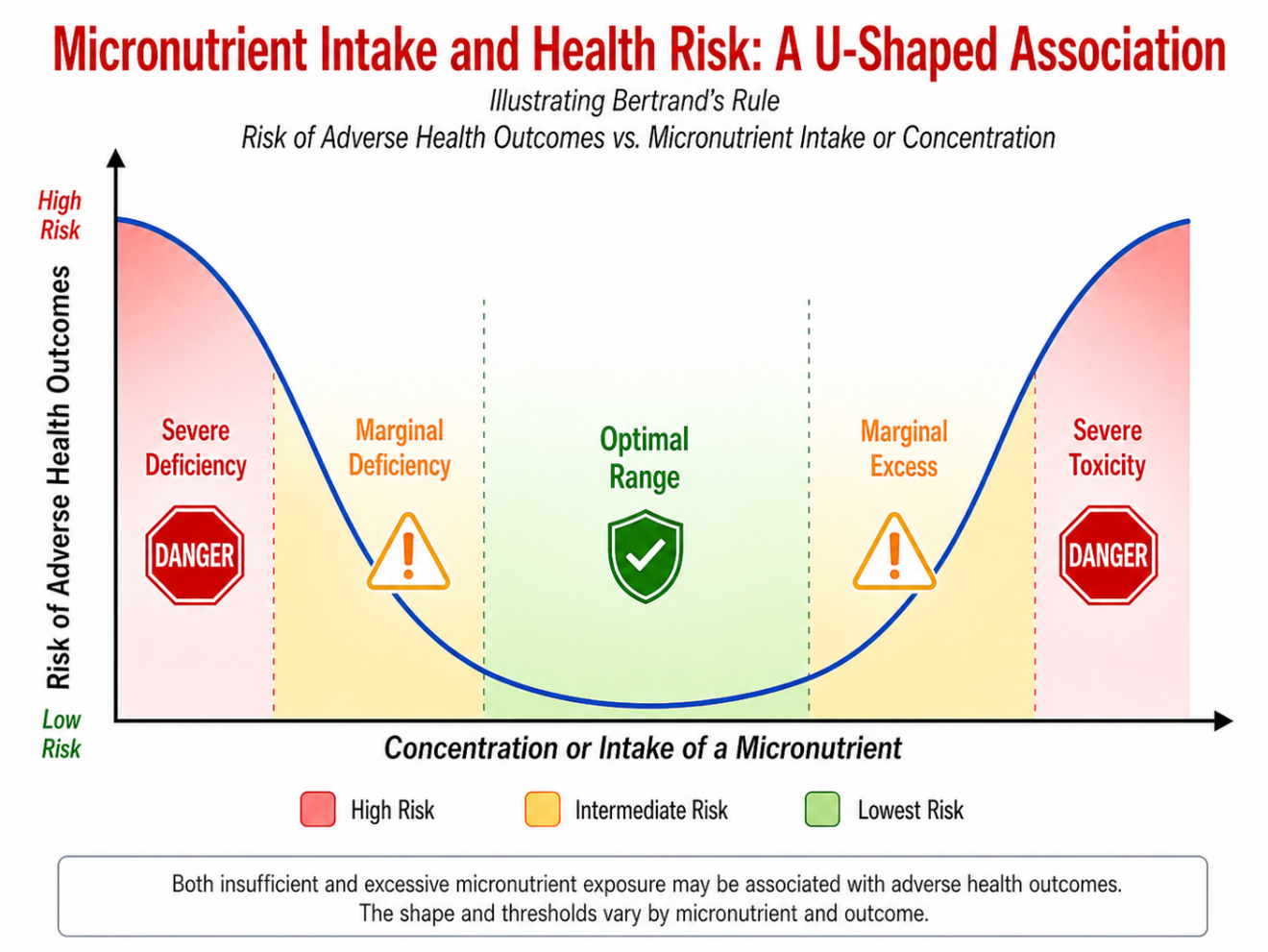
U-shaped curve: both very low and very high micronutrient intake are associated with higher risk, with the lowest risk in the moderate middle.
The body isn’t a bucket you want to fill as high as possible. It’s a thermostat you want to set correctly.
For most of this newsletter I’ve been pounding the table for more — start early, get up to at least 600 micrograms of folate in your prenatal, don’t settle for a bare folate-only tablet. All true, because so many sit on the deficient, left-hand slope of the valley, and getting to enough is the whole battle. But the deeper checklist respects the other wall of the valley too. And a small, careful body of evidence suggests that for the specific question of autism, that far wall may be real.
What Boston actually found
Remember the Boston Birth Cohort, the study I kept promising to come back to. Here’s the part I saved for this post.
When researchers sorted mothers by how often they took prenatal vitamins, they made a shocking finding. Children of the mothers taking prenatal vitamins 3 to 5 days a week had the lowest rate of autism. By far. Seventy percent lower than the 0-to-2-days-a-week group. And, perhaps most surprising, 57% lower than the 6-to-7-days-a-week group. Stated another way: doing the conventional “right thing,” taking prenatals every day, seven days a week, was associated with more than double the rate of autism compared with five days a week. [1]
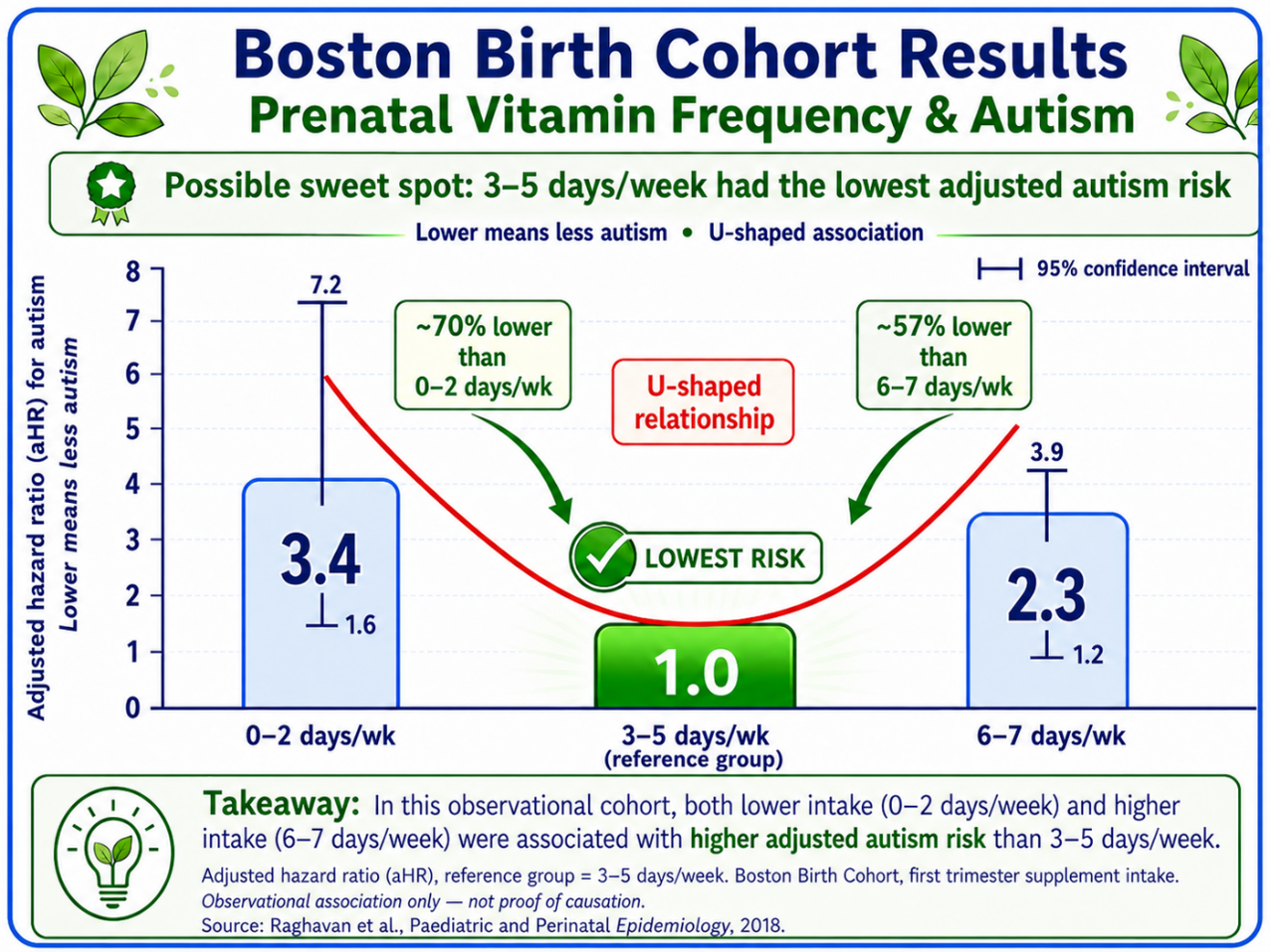
Boston Birth Cohort: prenatal vitamin frequency and autism risk. The 3-to-5-days-per-week group had the lowest rate. [1, 2]
The diagram illustrates the study’s findings showing that the optimal prenatal vitamin intake frequency for reducing autism risk may be 3-5 days per week, with both lower and higher frequencies associated with increased risks compared to this range. [1, 2]
And when they measured actual nutrient levels in the mothers’ blood, the pattern held at the extremes. Mothers with very high plasma folate had about 2.5 times the autism risk of those in the healthy middle (95% CI 1.3–4.6). Very high B12: also about 2.5 times (95% CI 1.4–4.5). And the risk was highest of all when both folate and B12 were in the top 10% at the same time.
I want to be scrupulously fair about what this does and doesn’t mean, because it’s easy to twist. The authors said it plainly: their finding “does not question the importance of consuming adequate folic acid” during pregnancy. This is not evidence to take less than you need. It’s a caution against the assumption — so common — that if some is good, a mountain must be better. On this curve, the mountain isn’t the goal. The valley floor is.
It isn’t only Boston
If it were a single study, I’d hold it loosely. It isn’t.
In Finland, a national study of more than 1,500 autism cases (the FIPS-A cohort) measured mothers’ actual B12 in early-pregnancy blood. Mothers with B12 levels in the top quintile had about 59% higher odds of having a child with childhood autism (adjusted odds ratio 1.59, 95% CI 1.06–2.41). [3] A separate country, a separate design — and the same warning flag on the too-much end for B12.
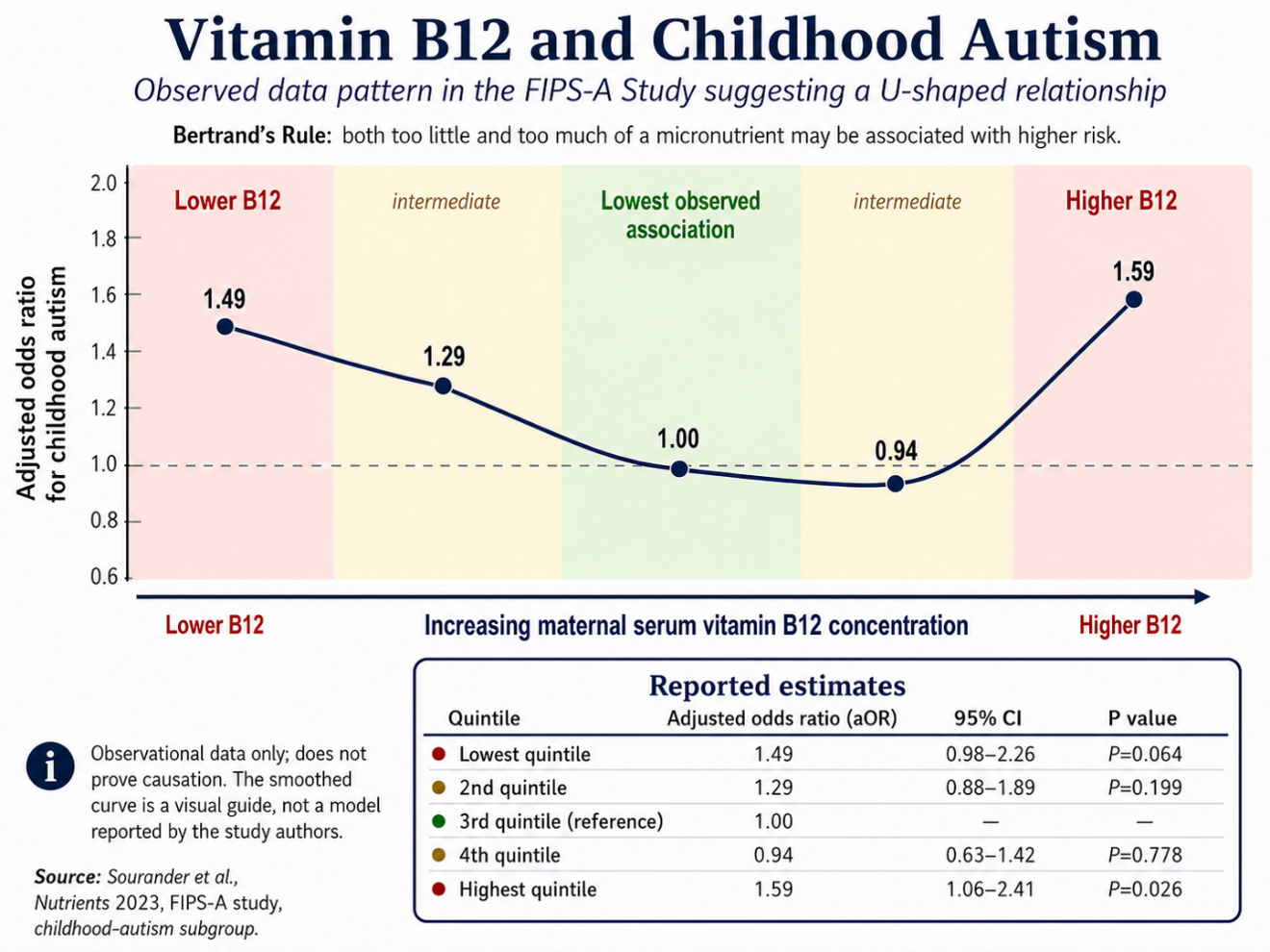
Maternal serum vitamin B12 and childhood autism in the Finnish FIPS-A cohort: a U-shaped pattern with higher risk at both extremes.
The FIPS-A study depicts a U-shaped association, suggesting that both very low and high levels of maternal serum vitamin B12 may correlate with an increased risk of childhood autism.
And in 2025, a systematic review in Reproductive BioMedicine Online gathered the research on excess folic acid and high blood folate around pregnancy and concluded it was linked to several adverse outcomes — higher gestational diabetes risk among them, alongside the autism-related signals other groups have raised. [4]
None of this is settled. All of it is the kind of thing a careful person files under reasons not to megadose.
“But won’t skipping days risk spina bifida?”
This is the first objection anyone raises, and it deserves a straight answer rather than a dodge.
The famous proof that folic acid prevents neural tube defects comes from randomized trials run in the early 1990s — before the United States began fortifying grain with folic acid in 1998. In today’s fortified America, the picture looks different. When researchers examined spina bifida specifically in the fortification era, regular folic acid supplementation did not appear to add further protection; the benefit tracked instead with natural dietary folate. [5]
The frequency of these two conditions is worth considering, too. Spina bifida and other neural tube defects affect roughly 1 in 1,000 pregnancies. [6] Autism now affects about 1 in 31 children. [7] They aren’t the same kind of outcome, and I’m not waving the first away — but the numbers tell you how much the everyday stakes have shifted.
None of this is license to let your folate fall short, and note that the proposal below doesn’t. It’s a reason to stop assuming that more, every single day, layered on top of an already-fortified food supply, is automatically safer.
This proposal does not lower your total folate intake. Adequate folate through the first month is sacred. My proposal is not “take less folate.” It is to deliver roughly the same weekly amount — a daily average on the order of 600 to 800 micrograms of methylfolate — across five days instead of seven, using a slightly higher per-dose amount. Same fuel, fewer fill-ups. The thinking is that skipping prenatals two days a week gives the body room to clear any excess rather than sitting at a continuously elevated level. The goal is to recreate the intervention associated with the greatest reduction in the rate of autism in the literature: prenatal vitamins five days a week, as seen in the Boston Birth Cohort.
Which means the number on the bottle matters as much as the number of days. At the time of that Boston Birth Cohort study, American prenatals were built around 800 to 1,000 micrograms of folate [8–11]; CHARGE [12, 13] and MARBLES [14] documented that nearly all mothers taking a prenatal were above 600. Many newer prenatals carry far less — some list only about 600 mcg DFE, which is roughly 360 micrograms of actual folate. Five days a week of one of those lower dose prenatals works out to a daily average near 250 micrograms, nowhere close to the 600 target, and nothing like the higher dose that those Boston mothers were taking. The proposal is for fewer days, not a lower dose pill. Note the goal is still an average daily folate intake of 600 to 800 mcg (equals about 1,000 to 1,360 mcg DFE), similar to what the women in the Boston Birth Cohort were taking.
If this idea tempts you, read it the safe way — not as take less than you need, but as don’t chase the mountain. Get to adequate, stay complete, don’t megadose, and talk it through with your own doctor before changing a single thing. One exception worth naming: if you’ve had a pregnancy affected by a neural tube defect, or your physician has you on daily high-dose folate for a specific reason, follow that advice instead. I’m sharing a proposal I turn over at the foot of my son’s bed. I’m not handing you an instruction.
And remember the folate is most critical in the first trimester only. For spina bifida, and potentially for autism too. The autism evidence seems to support cutting back to a lower dose after the first trimester, as noted in the checklist.
What else is on the deeper checklist
Beyond the moderation idea, the deeper version adds a few things worth knowing:
Methylfolate over folic acid. The already-active form (L-methylfolate, methyltetrahydrofolate, or 5-MTHF) skips the conversion step that the common MTHFR gene variant slows down — and it doesn’t leave behind unmetabolized folic acid, the circulating excess that some of these very studies worry about. It’s a way to be complete without pushing toward the far wall of the valley. In a study we’ll cover, higher unmetabolized folic acid in umbilical cord blood was associated with a higher rate of autism, while higher methylfolate was not — implying that methylfolate may be the safer option. [15] (It deserves its own post, and it’ll get one.)
Follow-up labs, a few months in. The moderation principle made practical. Two to three months after starting a prenatal, recheck folate, B12, vitamin D, and ferritin — not only to catch a deficiency, but to confirm you’re in the healthy middle rather than sky-high. You can’t aim for the moderate middle if you never measure where you are.
The rest of a real preconception workup. Screening for infections and, per medical guidelines, genetic carrier status; getting chronic conditions, such as diabetes and hypertension, well controlled; and steering clear of the medications and toxins that matter most in early pregnancy. It’s all in the downloadable deeper checklist — more than fits here, and all worth reviewing with your clinician.
The whole point, in one sandwich
Strip away the studies and it comes back to Luke at the kitchen table. One sandwich is just right. Not zero. Not two. The body knows the difference between not enough, just right, and too much. This deeper checklist is really just an attempt to harmonize with that concept.
Next time, the investigation pauses for the most personal chapter I’ll write — the years we weren’t sure we’d ever have the family we have now. Then the trail resumes in Japan and China, where the dose clue does something I never saw coming.
— Jeff Zadeh, M.D.
General education from one physician’s perspective, not medical advice. The moderation and dosing ideas here are hypotheses drawn from observational studies — association, not proof, and not a reason to take less folate than recommended. The established recommendation is a daily prenatal. Please make decisions with your own clinician.
References
[1] Raghavan R, Riley AW, Volk H, et al. Maternal multivitamin intake, plasma folate and vitamin B12 levels and autism spectrum disorder risk in offspring. Paediatr Perinat Epidemiol. 2018;32(1):100–111. doi:10.1111/ppe.12414. Source. A U-shaped association between prenatal multivitamin frequency and autism, with the 3-to-5-times-per-week group at lowest risk and both lower- and higher-frequency groups elevated.
[2] World Health Organization. Guideline: intermittent iron and folic acid supplementation in menstruating women. Geneva: World Health Organization; 2011. ISBN 9789241502023. Source. Intermittent dosing of folate is not unprecedented, though the context differs. The World Health Organization already recommends intermittent rather than daily folic acid in a different setting: a once-weekly supplement containing 60 mg of elemental iron and 2,800 mcg of folic acid, given for three months and then paused for three months, for menstruating women living where anaemia is highly prevalent. That is a strong recommendation, and the WHO Essential Medicines List committee noted that weekly intermittent supplementation is associated with efficacy outcomes similar to daily supplementation, with potentially fewer adverse effects. The regimen is weekly high-dose rather than a daily dose with days skipped, and it is aimed at anaemia rather than neurodevelopment, so it does not test the schedule proposed here. It does show that folate status need not depend on taking a supplement every single day.
[3] Sourander A, Silwal S, Surcel HM, et al. Maternal serum vitamin B12 during pregnancy and offspring autism spectrum disorder. Nutrients. 2023;15(8):2009. doi:10.3390/nu15082009. Source. High maternal B12 was significantly associated with offspring childhood autism specifically; no significant association was seen for Asperger’s syndrome or PDD-NOS.
[4] Ledowsky C, Scarf V, Sobczyńska-Malefora A, Carter T, Timbrell NE, Steel A. Effects of excess folic acid and high blood folate during preconception and pregnancy: systematic review. Reprod Biomed Online. 2026;53(2):105240. doi:10.1016/j.rbmo.2025.105240. Published online September 12, 2025. Source
[5] Ahrens K, Yazdy MM, Mitchell AA, Werler MM. Folic acid intake and spina bifida in the era of dietary folic acid fortification. Epidemiology. 2011;22(5):731–737. doi:10.1097/EDE.0b013e3182227887. Source. In the US fortification era, regular folic acid supplementation (at least four days per week) was not associated with reduced spina bifida risk (adjusted OR 1.1, 95% CI 0.74–1.7); the protective association tracked with dietary folate intake.
[6] Duke Molecular Physiology Institute. Neural tube defects (NTDs). Accessed October 5, 2026. Source. The Duke page describes approximately one in 1,000 live births in the United States; its denominator is live births, rather than all pregnancies.
[7] Shaw KA, Williams S, Patrick ME, et al. Prevalence and early identification of autism spectrum disorder among children aged 4 and 8 years — Autism and Developmental Disabilities Monitoring Network, 16 sites, United States, 2022. MMWR Surveill Summ. 2025;74(2):1–22. doi:10.15585/mmwr.ss7402a1. Source. The one-in-31 estimate refers to children aged 8 years in the participating surveillance areas in 2022.
[8] Food and Drug Administration, HHS. Food additives permitted for direct addition to food for human consumption; folic acid (folacin). Final rule. 61 Fed Reg. 8797–8807 (March 5, 1996). Docket No. 91N-100F. Source. Historical US prenatal formulation context; not a measurement of individual Boston Birth Cohort participants’ doses.
[9] Morrell MJ. Folic acid and epilepsy. Epilepsy Curr. 2002;2(2):31–34. doi:10.1111/j.1535-7597.2002.00017.x. Source. Describes over-the-counter prenatal vitamins containing 800 mcg of folic acid and prescription prenatal vitamins containing 1,000 mcg.
[10] Saldanha LG, Dwyer JT, Potischman N, Andrews K. Folic acid in prenatal supplements: labeled amounts compared to recommendations (P11-024-19). Curr Dev Nutr. 2019;3(Suppl 1):nzz048.P11-024-19. doi:10.1093/cdn/nzz048.P11-024-19. Source. Conference abstract reporting a prenatal supplement label audit; product-label amounts do not establish individual cohort participants’ intakes.
[11] Saldanha LG, Dwyer JT, Haggans CJ, Mills JL, Potischman N. Perspective: time to resolve confusion on folate amounts, units, and forms in prenatal supplements. Adv Nutr. 2020;11(4):753–759. doi:10.1093/advances/nmaa017. Source
[12] Schmidt RJ, Hansen RL, Hartiala J, et al. Prenatal vitamins, one-carbon metabolism gene variants, and risk for autism. Epidemiology. 2011;22(4):476–485. doi:10.1097/EDE.0b013e31821d0e30. Source. CHARGE 2011 case-control study of periconceptional prenatal vitamin use and autism. Included as the earlier CHARGE report; the dose-specific analysis is reference [13].
[13] Schmidt RJ, Tancredi DJ, Ozonoff S, et al. Maternal periconceptional folic acid intake and risk of autism spectrum disorders and developmental delay in the CHARGE (CHildhood Autism Risks from Genetics and Environment) case-control study. Am J Clin Nutr. 2012;96(1):80–89. doi:10.3945/ajcn.110.004416. Source
[14] Schmidt RJ, Iosif AM, Guerrero Angel E, Ozonoff S. Association of maternal prenatal vitamin use with risk for autism spectrum disorder recurrence in young siblings. JAMA Psychiatry. 2019;76(4):391–398. doi:10.1001/jamapsychiatry.2018.3901. Source. MARBLES study.
[15] Raghavan R, Selhub J, Paul L, et al. A prospective birth cohort study on cord blood folate subtypes and risk of autism spectrum disorder. Am J Clin Nutr. 2020;112(5):1304–1317. doi:10.1093/ajcn/nqaa208. Source