


Season 1 · Episode 1 of 8
The Basic Pregnancy Preparation Checklist is at the bottom of this post, free to download. The story below is why I made it.
On trash day, we used to pack a small picnic and carry it out to the curb.
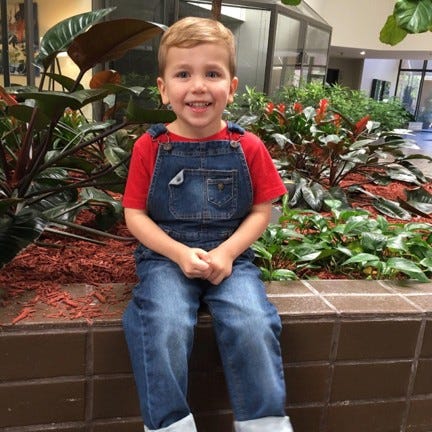
My oldest son, Luke, would practically vibrate waiting for the truck to round the corner. When it finally came — the hiss of the hydraulics, the roar of the engine, the men stepping off the riding step to empty the garbage can into the hopper — he lit up like it was the Fourth of July. The workers waved and grinned. He recognized them, because of course he did. He knows nearly everyone’s name. He knows what kind of dog you have, how many, whether they’re boys or girls, and what you wore the last time he saw you. He also may walk away mid-sentence as you answer his many questions.
You see, Luke has autism. And I would not trade him for anyone.
Before bed, Luke and his little brother lie in the dark reciting entire Netflix episodes from memory, laughing until they can’t breathe. If his little sister cries for Luke’s toy or candy, Luke just hands it over. No argument. Done. He would give you the shirt off his back if he thought it would make you smile. This from a boy who is supposed to have a disorder of social connection. I don’t know how anyone could possibly not love Luke.
But loving Luke does not require me to pretend that his struggles are small, or that the stakes aren’t, at times, terrifying.
The pond
Once, Luke walked into the pond beside our house because he saw a piece of garbage floating near the bank. Garbage fascinates him; he wanted it. By the time we reached him, the water was at his neck. He knows how to swim. That is not what made the scene safe or unsafe. The danger was that his mind had locked onto that floating trash and pushed everything else — the depth, the cold, the slick mud, the possibility of panic — clean outside the frame. Like so many with autism, Luke’s impulsive moment can become an injury before you know it.
The day the ground moved
Luke was three, and our first, so we had no baseline. He laughed. He would meet your eyes. But he didn’t always answer to his name, and he could lock so deeply into what he was doing that he played beside you rather than with you. First-time parents, we mostly thought: spirited kid.
We were trying to get him into a competitive preschool — the kind with an admissions test. A psychologist ran the admissions evaluation. Luke walked in and, one by one, turned over every game in the room, delighted, while the tester’s frustration grew. His language wasn’t where it should have been, so she suggested a speech evaluation. There, the speech therapist mentioned potential autism for the first time. Then came the full workup.
I was driving back from Pecos, a dusty little town in West Texas, where I’d gone to look at a practice opportunity. Late summer, hot, flat land stretching to the horizon in every direction. My phone rang.
Luke has autism.
The words didn’t really sink in at first. I kept driving. The road kept going. But underneath, I already knew what they meant, because the children of people close to me have autism. I knew what those words could carry: years of therapy, the real possibility that my boy might never live on his own, might never have a family of his own. The flat desert slid past the window, and everything felt unreal — as if my life had quietly split in two. After the call, I felt even hotter. The AC that had been barely adequate suddenly felt like nothing at all. The disbelief — you could call it denial — lasted for days.
The tears came later when we sat with the psychologist to go through the full results. A small office, plush chairs, a coffee table. She was extraordinarily warm — I think because her own only child is autistic. She knew what those words cost. We had gone from trying to get Luke into a competitive preschool to wondering whether he would ever be able to take care of himself.
I don’t tell you this for sympathy. I tell you because that initial grief, and that love for Luke, are the engine behind everything that follows.
The confession
I am a physician — board-certified in internal medicine. I work sixty-hour weeks as a hospitalist and emergency room doctor in a small Texas town. I have spent my whole adult life handing people health advice I believed in. So it is humbling to admit that when it came to my own family, I skipped the most basic advice I’d have given any patient.
We did not start a prenatal vitamin before pregnancy. The reason is almost embarrassing: I’m the doctor in the family. I had it filed away that prenatals were mostly about preventing spina bifida — which is rare — so why bother? We’d just eat a little healthier. That was my expert clinical opinion. Delivered to myself. Never once checked against the recent literature.
The problem wasn’t that I looked at the evidence and disagreed with it. It’s that I was so sure I already knew the answer that I never looked.
The awakening
When Luke was five, he went through a rough irritable stretch. Desperate, we would have tried just about anything. My brother, who is also an internist, suggested a Tampa pediatrician that he personally saw work wonders. I checked out the doc’s website.
What I saw on there sparked a fascination — and set me on a mission ever since. I clicked on a simple tab called “preconception counseling.” The doc laid out simple steps taken BEFORE pregnancy that might lower the chance of your kid ever getting autism in the first place.
The references on the pediatrician’s website were out of date, over a decade old, but they got me thinking. And digging. And that is when I fell down a rabbit hole I have not climbed out of.
What I found were not fringe blogs. Quite the opposite. JAMA, The American Journal of Clinical Nutrition, Johns Hopkins researchers funded by the NIH. Study after study suggesting that something as ordinary as an adequately dosed prenatal vitamin, started before pregnancy, was associated with substantially lower rates of autism. In one study of higher-risk families, the autism rate roughly halved for those starting prenatals early.[1] My first feeling wasn’t hope. It was disbelief — that I, a physician, had never heard a word of it.
What this newsletter is — and isn’t
Let me be careful, because this is where trust is won or lost.
I am not telling you a vitamin would have changed Luke’s story. These studies describe populations, not any single child. Autism is highly heritable and profoundly complex; no supplement rewrites one kid’s life. And nothing here is a judgment of any autistic person, or of the families who love them. Luke’s life is not a cautionary tale. It is a good life — full of garbage trucks, laughter and candy he gives away.
What I can tell you is this: there is real, consistent research linking early prenatal vitamins to meaningfully lower autism rates. The intervention is cheap. It’s safe. It’s already recommended. And almost no one — including the doctors I’ve spent two years asking — seems to know it exists. That gap is what I’m here to close. I’ll show you the actual studies, tell you plainly what’s proven and what’s only suggestive, and let you and your own doctor decide.
And there is a mystery underneath all of it — one that took me over two years, a half-forgotten college language, and more than one hot chocolate in a Starbucks to solve. Because the world’s biggest studies seemed to contradict each other. Dramatic results in America. Nothing at all in Denmark and Japan. The field looked at the mess, called it inconclusive, and moved on.
I couldn’t. And when I finally understood why those studies disagreed, it came down to a single number that no published analysis I can find had ever noticed.
I’ll get there. But it starts with something simpler, and more urgent: laying the foundation of a child’s health before most women even know they are pregnant.
If a pregnancy is anywhere on your horizon — or you love someone in that season — subscribe, and grab the free checklist below. And if any of this rings true, tell one person. The algorithms won’t carry this message. The big podcasts skip it. Doctors generally don’t know it. It travels the old way — one person to another — or it doesn’t travel at all.
And Luke? He straightened himself out on his own. We think it was mostly a growth spurt.
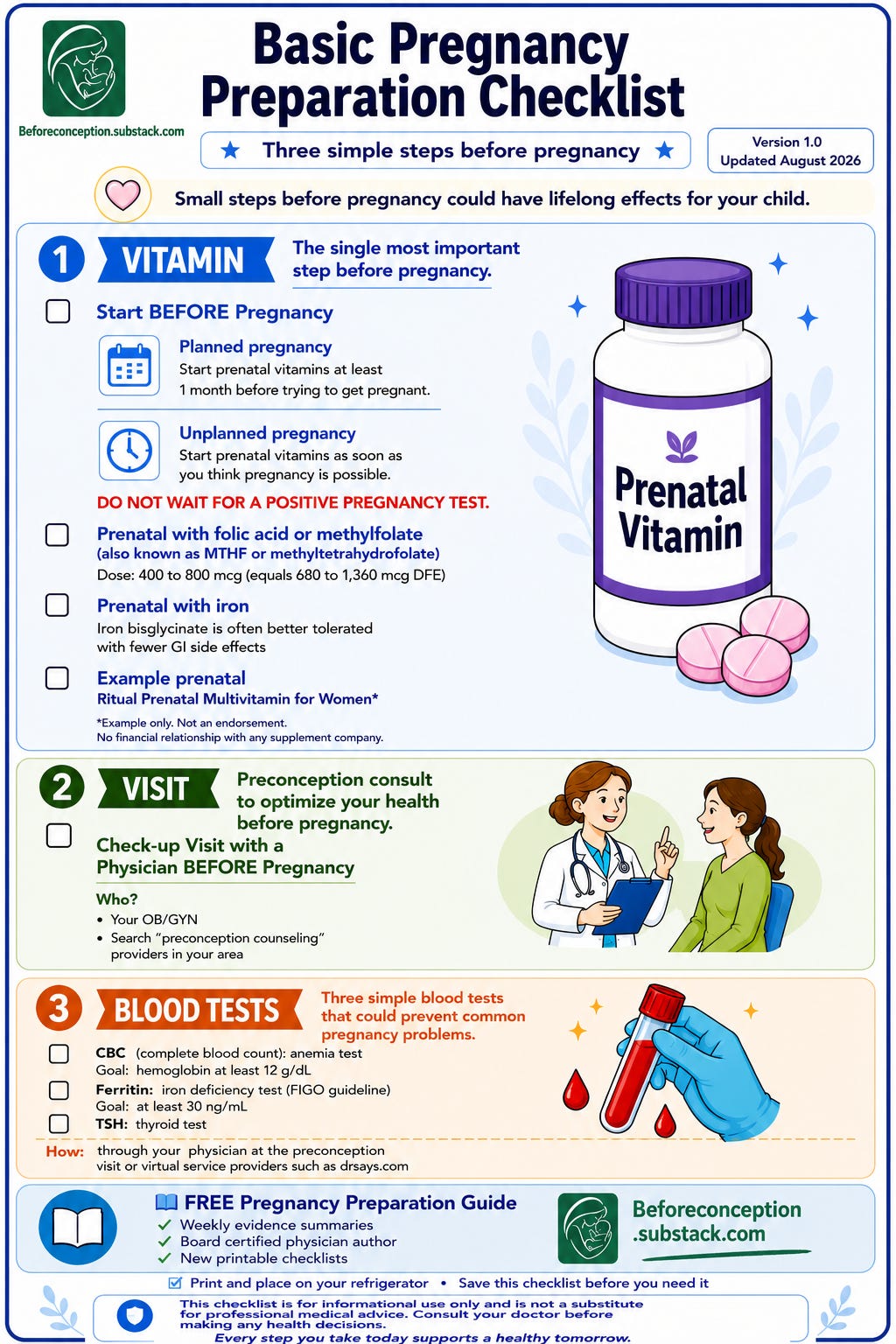
The Basic Pregnancy Preparation Checklist
Three steps. Nothing here is controversial, and all of it is worth doing today. Print it, put it on the fridge, or take it to your doctor.
Next time: the dinner where four doctors — four for four — heard this for the first time. One of them left the table on a mission.
Eight episodes, in order. I’m starting with the parts nobody argues about, because the parts that matter most only make sense once the foundation is there.
— Jeff Zadeh, M.D.
General education from one physician’s perspective, not medical advice. The autism-related research described here is observational — association, not proof of cause — and cannot predict any individual child’s outcome. Please make decisions with your own clinician.
[1] Schmidt RJ, Iosif AM, Guerrero Angel E, Ozonoff S. Association of maternal prenatal vitamin use with risk for autism spectrum disorder recurrence in young siblings. JAMA Psychiatry. 2019;76(4):391–398. Autism was diagnosed in 14.1% of children whose mothers took a prenatal vitamin in the first month of pregnancy versus 32.7% of those who did not (adjusted relative risk 0.50, 95% CI 0.30–0.81).