


Season 1 · Episode 5 of 8
The Beatles were not the only revelation to come out of Liverpool circa 1960. They were actually known as the Quarrymen at first, honing their vocal harmonies in a local coffee shop called the Casbah. A few miles away, a quiet, energetic paediatrician named Richard Smithells meticulously recorded birth defects for the local register.
Smithells documented an alarming rate of spina bifida, one of the highest in the world. His determination to prevent it would span decades and change what basically all of us eat every day.

The question for this post: why did the medical establishment take almost three decades to fully acknowledge his discoveries on folate and spina bifida? And are we making the exact same mistakes today, with the exact same vitamin, but this time for autism? Prenatal multivitamins containing folate are associated with a lower rate of autism. Yet the public and even doctors are still in the dark. The medical establishment has yet to spread the word. Is history repeating itself?
Let’s explore.
The year is 1965. The Beatles had recently met Bob Dylan in a New York hotel room. Their music changed. More introspective, less teenage puppy love. Goodbye “I Want to Hold Your Hand.” Hello “Strawberry Fields Forever.”
That same year Smithells made a major breakthrough. Mothers with low functional folate levels were much more likely to birth a child with spina bifida or another neural tube defect. Published in the Lancet, the study planted a seed. [1] Maybe birth defects are not all acts of God. Maybe some can be prevented with simple nutrition.
The Beatles would play their last ticketed concert in 1966 at Candlestick Park in San Francisco. They grew tired of the sheer chaos of Beatlemania. They would record their last album as a four-piece band, Abbey Road, in 1969 before going their separate ways.
Smithells forged ahead.
In the 1970s, he recruited women who already had a child with a neural tube defect and were therefore at much higher risk of having a second. The “heartbreak mums,” as the tabloids called them. [2] Those who agreed to take a multivitamin containing folic acid, called Pregnavite Forte F, went in one arm of the study. Those who refused went in the other. The prenatal folic acid group had a striking 89% lower rate of neural tube defects in their children, as published in the Lancet in 1980. [3]
Blunderbuss
The medical establishment scoffed.
Blunderbuss. The Lancet carried that insult in its correspondence section. [2] Blunderbuss can mean bumbling and oafish, or an instrument that lacks precision — such as a musket with a barrel so short it sprays its shot everywhere inaccurately.
The study was not properly controlled and could not possibly determine cause and effect, wrote the critics. However, Smithells had actually requested a placebo control group. His hospital ethics committee refused to give permission.
The very next year, 1981, saw the publication of the South Wales trial, a true randomized controlled trial. The headline essentially stated: inconclusive. No statistically significant association between folic acid and neural tube defects in the intent-to-treat analysis. [4] Even more cold water thrown on Smithells’ theory.
However, the South Wales trial was simply too small, only 111 women in total. And its headline failed to account for the fact that many women were noncompliant with the folic acid, which showed up in their low folate blood levels. Among the women who actually took the folic acid, the rate of neural tube defects was substantially lower.
But those details were covered in a post-hoc sub-analysis. The critics feasted on the imperfections. Blunderbuss lived on. Smithells’ folic acid theory took a blow.
The final verdict came in 1991. The large placebo-controlled MRC Vitamin Study had to be halted early for ethical reasons. The results were so overwhelmingly positive. A 72% reduction with folic acid. [5]
That is why essentially every medical guideline now recommends women start folic acid before pregnancy, and why our grains in the US are fortified with it.
Smithells had been right all along. It took the establishment 26 years to catch up.
And the MRC authors snubbed him. No active role in the study itself. Not even a mention in acknowledgement section. A “galling” omission, according to historians. [6]
Folate and autism
The folate and spina bifida results unleashed a massive wave of research on another front: autism. If prenatal folate could reduce neural tube defects, what else could it reduce? Studies launched in the late 1990s would cost tens of millions of dollars and take more than a decade.
Two major early studies showed promise. CHARGE in 2012 [7, 8] and the Norwegian Mother and Child Cohort in 2013 [9] each showed a significant association with lower autism rates, about 40%.
And then the momentum came to a screeching halt.
The Danish National Birth Cohort study was published in 2016. It found absolutely no association at all between prenatal vitamins and autism. Nothing. Not even a hint. [10] It was a massive study, about 35,000 mother–child pairs. And it was the highest quality study that can ethically be done on this question, something called a prospective cohort study.
If you want to know why you and your doctor have probably never heard about the prenatal vitamin and autism association, it is right here. This study is the biggest stumbling block.
But was the Danish study just another South Wales head fake?
The authors themselves suggested that possibility. They noted the folate dose taken by Danish mothers may simply have been too low:
“it is possible that the DNBC women who used supplements never reached a high enough level of fortification to reduce ASD [autism] risk.”
— Virk et al., Danish National Birth Cohort study, 2016 [10]
In fact, the most popular Danish prenatal multivitamin contained just 200 mcg of folic acid, [11] a paltry amount by today’s standards. CHARGE specifically noted a threshold of 600 mcg, a figure that would be supported again in the MARBLES study published in 2019. [12] And in the US, prenatal multivitamins generally contained 800 mcg of folic acid at the time of the CHARGE and MARBLES studies. [13–16]
Imagine this analogy. Studies repeatedly show that 800 mg of amoxicillin treats strep throat. One study shows that 200 mg of amoxicillin does not consistently treat strep throat. And then somehow the medical establishment concludes that amoxicillin does not consistently treat strep throat and should not be recommended. Somehow the establishment completely misses the importance of the higher dose.
I believe that analogy shows where we are right now with folate and autism.
The first five
Let’s keep the 600 mcg threshold in mind and look at the first five highest quality prospective cohort studies on the topic — ambitious studies that began in the late 1990s, not long after the MRC trial.
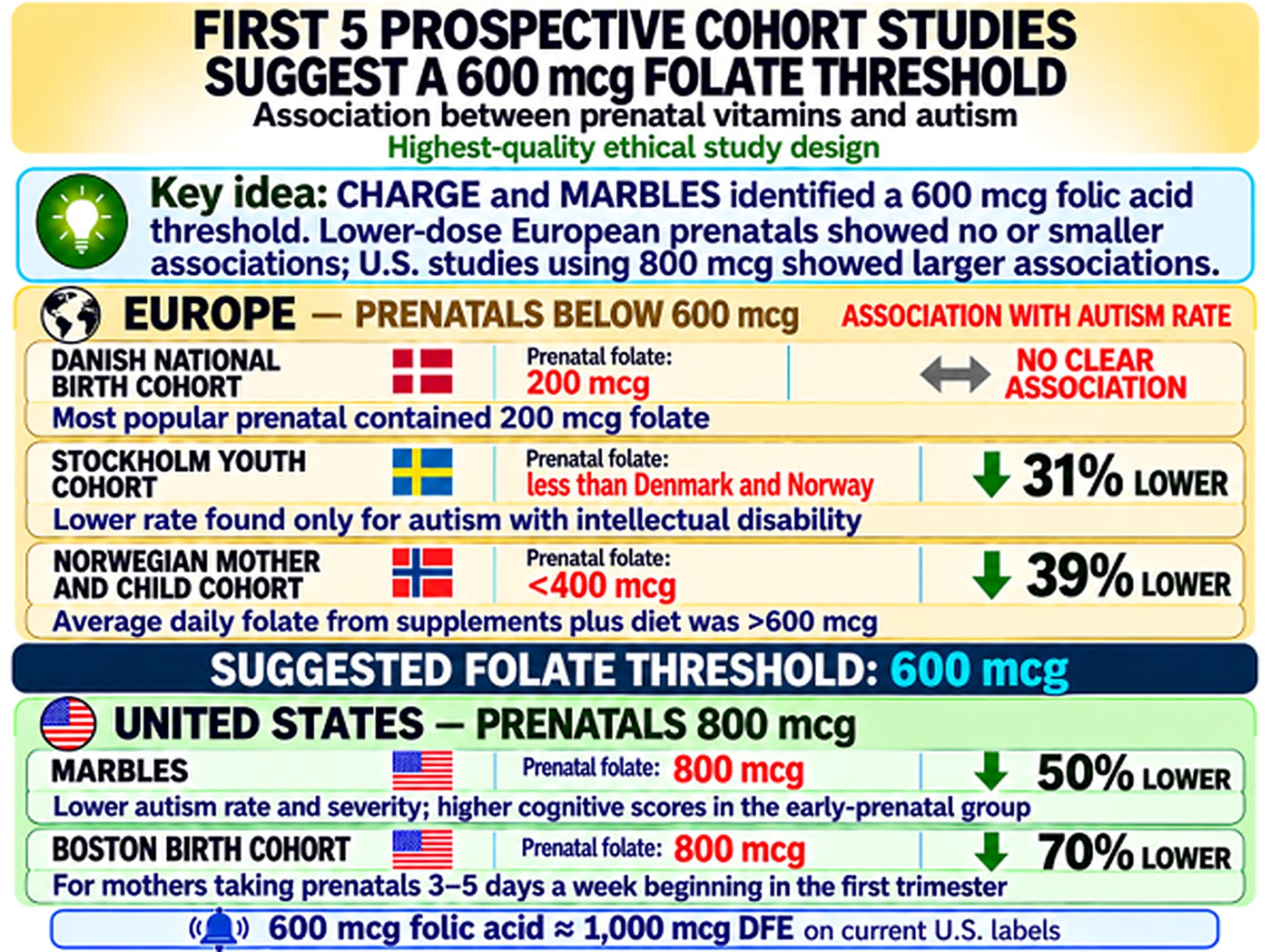
A clear pattern seems to emerge. Above 600 mcg, the association between prenatal vitamins containing folate and lower rates of autism is consistent. Below 600 mcg, the results are mixed. [17, 18]
Yet I cannot find any analysis looking at the data through this frame. Instead, here is the NIH. [19]
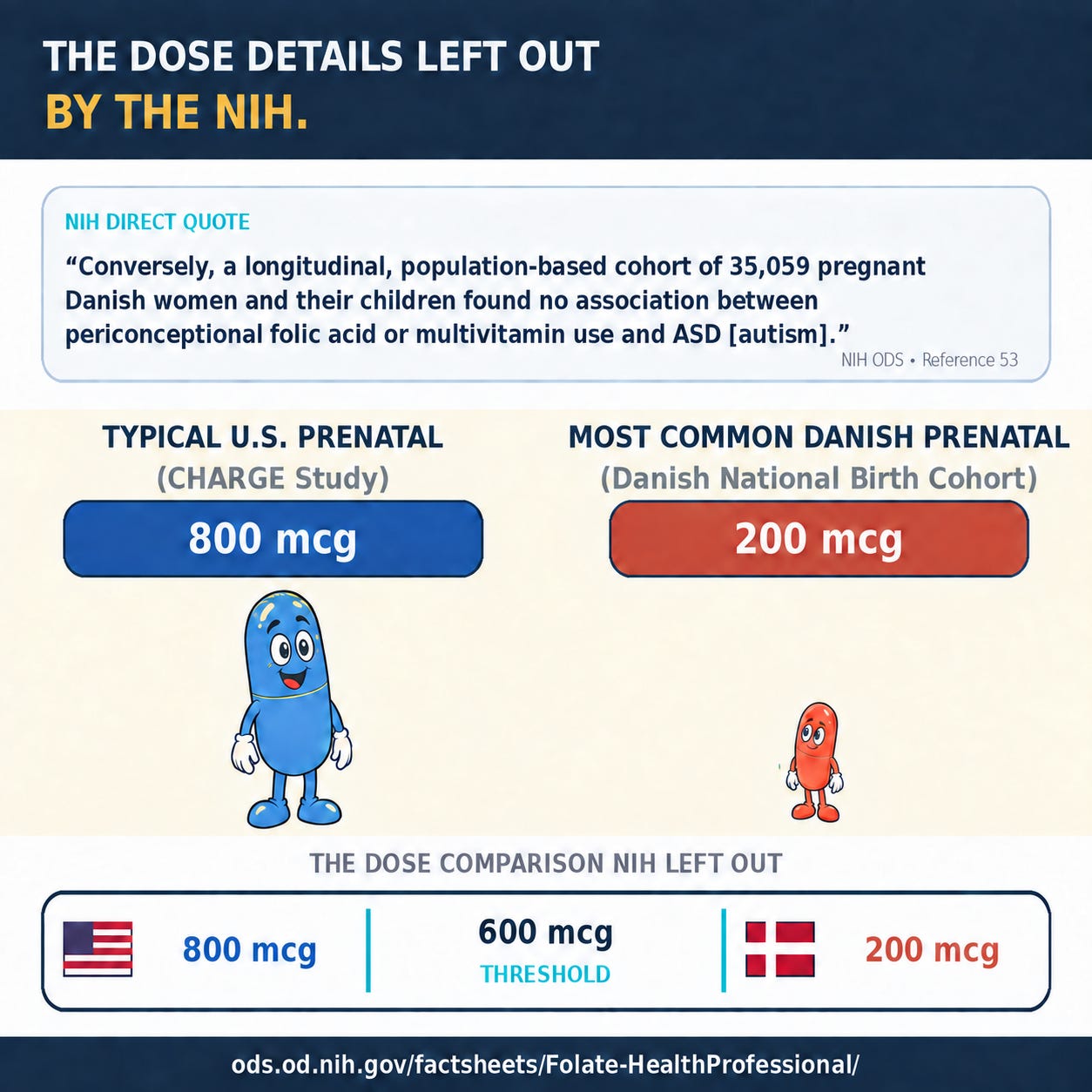
This NIH analysis mentions only the headline: no association in the Danish study. It does not mention the 200 mcg dose at all.
Are we living through the South Wales moment all over again? With the exact same vitamin?
Why nobody noticed the dose
To be fair, the dosing information is incredibly difficult to find, and often is not in the studies themselves.
The 200 mcg Danish dose? First I had to cough up forty bucks to get behind the paywall — and I hate paying to get past paywalls — only to find that the dose was not in the publication itself. It was buried in a supplemental appendix I had to download separately.
The 800 mcg figure in the Boston Birth Cohort was not recorded at all. I had to piece it together from sources before, during and after the study, all showing that the vast majority of US prenatal vitamins contained 800 to 1,000 mcg at the time. So the dose comparison is my interpretation with the full explanation in the references below. [13–17]
Smithells’ critics would not be impressed with the imprecise information on the dosing. However, other than CHARGE and MARBLES, these studies simply did not focus on the dose.
What now
Unfortunately, there is no definitive randomized placebo controlled trial coming to the rescue this time. No final verdict. At this point it would be unethical to withhold prenatal vitamins from half the women in such a study, especially now that we know they prevent spina bifida.
So is there enough data to support a guideline anyway? Something like: before pregnancy, start a prenatal multivitamin containing 600 to 800 mcg of folate.
I believe there is. Most of our guidelines rest on moderate quality evidence at best, the same level we already have for prenatal vitamins and autism. It is in fact rare for a guideline to be supported by the highest level of evidence that Smithells’ critics demanded. [20]
And in late 2025, a group of researchers reached the same conclusion after an umbrella review of the prenatal vitamin and autism research:
“Policymakers should prioritize the inclusion of folic acid and multivitamin supplementation in national maternal health guidelines and public health initiatives. Public awareness campaigns are needed to educate women of reproductive age about the potential benefits of these supplements in reducing ASD [autism] risk.”
— Abate et al., PLOS ONE, 2025 [21]
Here are the government agencies and medical societies that have issued such a guideline for the general public.
None.
So we remain in the dark. Parents-to-be who may desperately want this information have no idea it exists. Their physicians don’t either. I ask nearly everyone I meet: physician colleagues, the therapists who treat my son’s autism, staff at my hospital, even Uber drivers. Many of them have loved ones with autism, which means their families carry a higher probability of autism in future children.
Not one of them had ever heard anything about the association between prenatal vitamins and autism.
Back to Smithells
Unknighted but not unappreciated, Smithells finally received the recognition he deserved: the James Spence Medal in 1992, the highest honour in British paediatrics. [22]
So much suffering could have been prevented if his work had been acknowledged earlier. I imagine it haunted him because I too feel this way at times. And drove him to keep going for decades, like a dog on a bone, refusing to give it up.
In retirement Smithells joined the bell-ringing team at his local church. [23] I like to imagine him content in the belfry, his message having finally spread, as the sounds of a Beatles cover band drift through the ancient stone openings.
What can be done?
You may be thinking: what can I do to help? Quite a bit, actually.
Spread the word. Share this Substack. Or better yet, make your own content. Maybe it will go viral. All of the references are open source. And nobody needs permission to take a prenatal vitamin.
— Jeff Zadeh, M.D.
No sponsorships. No affiliate links.
I have no financial relationship with any supplement company. Nobody paid me. Nobody sent me product. You won’t find an affiliate link anywhere in this post. I make my living as a physician taking care of patients.
Disclaimer
General education from one physician’s perspective, not individualized medical advice. The research discussed across this series is largely observational — showing associations, not definitive clinical proof of causation — and cannot predict any individual child’s neurodevelopmental outcome. Please review all supplement regimens with your personal healthcare provider.
References
[1] Hibbard ED, Smithells RW. Folic acid metabolism and human embryopathy. Lancet. 1965;285(7398):1254. doi:10.1016/S0140-6736(65)91895-7. Full text
[2] Al-Gailani S. Making birth defects “preventable”: pre-conceptional vitamin supplements and the politics of risk reduction. Stud Hist Philos Biol Biomed Sci. 2014;47(Pt B):278–289. doi:10.1016/j.shpsc.2013.10.009. Full text Historical account of the press coverage and controversy. For a direct published use of “an expensive blunderbuss preparation,” see Laurence et al. [4], p. 1511.
[3] Smithells RW, Sheppard S, Schorah CJ, et al. Possible prevention of neural-tube defects by periconceptional vitamin supplementation. Lancet. 1980;1(8164):339–340. doi:10.1016/S0140-6736(80)90886-7. Abstract The 1980 report found 1 affected fetus or infant among 178 in the fully supplemented group versus 13 among 260 in the unsupplemented group: approximately 89% lower observed recurrence. This was not a randomized comparison.
[4] Laurence KM, James N, Miller MH, Tennant GB, Campbell H. Double-blind randomised controlled trial of folate treatment before conception to prevent recurrence of neural-tube defects. Br Med J (Clin Res Ed). 1981;282(6275):1509–1511. doi:10.1136/bmj.282.6275.1509. Full text South Wales trial: 111 women randomized. The abstract explicitly reports the favorable adherence-based analysis; that analysis did not preserve the randomized comparison.
[5] MRC Vitamin Study Research Group. Prevention of neural tube defects: results of the Medical Research Council Vitamin Study. Lancet. 1991;338(8760):131–137. doi:10.1016/0140-6736(91)90133-A. Article
[6] Breimer LH, Nilsson T K. Ethical stumbling blocks in uncovering folate deficiency as a preventable cause of spina bifida. Indian J Med Ethics. 2017;2(4):260–265. doi:10.20529/IJME.2017.056. Full text Commentary on ethics review and recognition of earlier work. Its assertion that Smithells’ name appears nowhere in the MRC report is incorrect: the report names him and cites his studies. It does not list him among the study contributors or in its acknowledgements.
[7] Schmidt RJ, Tancredi DJ, Ozonoff S, et al. Maternal periconceptional folic acid intake and risk of autism spectrum disorders and developmental delay in the CHARGE (CHildhood Autism Risks from Genetics and Environment) case-control study. Am J Clin Nutr. 2012;96(1):80–89. doi:10.3945/ajcn.110.004416. Full text CHARGE 2012: the folic acid intake analysis.
[8] Schmidt RJ, Hansen RL, Hartiala J, et al. Prenatal vitamins, one-carbon metabolism gene variants, and risk for autism. Epidemiology. 2011;22(4):476–485. doi:10.1097/EDE.0b013e31821d0e30. Full text CHARGE 2011: the earlier prenatal-vitamin and gene–environment analysis. Both CHARGE publications are case-control analyses from the same research program, not two independent prospective cohorts.
[9] Surén P, Roth C, Bresnahan M, et al. Association between maternal use of folic acid supplements and risk of autism spectrum disorders in children. JAMA. 2013;309(6):570–577. doi:10.1001/jama.2012.155925. Full text Norwegian Mother and Child Cohort Study (MoBa).
[10] Virk J, Liew Z, Olsen J, Nohr EA, Catov JM, Ritz B. Preconceptional and prenatal supplementary folic acid and multivitamin intake and autism spectrum disorders. Autism. 2016;20(6):710–718. doi:10.1177/1362361315604076. Article Danish National Birth Cohort autism analysis; published online in 2015 and in the 2016 journal issue.
[11] Nohr EA, Olsen J, Bech BH, Bodnar LM, Olsen SF, Catov JM. Periconceptional intake of vitamins and fetal death: a cohort study on multivitamins and folate. Int J Epidemiol. 2014;43(1):174–184. doi:10.1093/ije/dyt214. Full text Open companion paper from the Danish National Birth Cohort. Table 1 describes the most commonly used multivitamin, including 200 mcg of folic acid. This documents a common formulation, not an individually measured 200 mcg dose for every participant in the autism analysis.
[12] Schmidt RJ, Iosif AM, Guerrero Angel E, Ozonoff S. Association of maternal prenatal vitamin use with risk for autism spectrum disorder recurrence in young siblings. JAMA Psychiatry. 2019;76(4):391–398. doi:10.1001/jamapsychiatry.2018.3901. Full text MARBLES. The study collected supplement information and analyzed folic acid intake, including categories below 600 and at least 600 mcg/day. A study cutoff does not by itself establish a minimum effective dose.
[13] Food and Drug Administration, HHS. Food additives permitted for direct addition to food for human consumption; folic acid (folacin). Final rule. 61 Fed Reg. 8797–8807 (March 5, 1996). Docket No. 91N-100F. Full text At p. 8798, the agency describes the former 800 mcg labeling reference for pregnancy; at p. 8799, it states that prenatal supplements usually contained 800 mcg of folic acid. This is historical market context, not measured exposure in the autism cohorts.
[14] Morrell MJ. Folic acid and epilepsy. Epilepsy Curr. 2002;2(2):31–34. doi:10.1111/j.1535-7597.2002.00017.x. Full text Describes over-the-counter prenatal vitamins as containing 0.8 mg (800 mcg) of folic acid and prescription prenatal vitamins as containing 1 mg (1,000 mcg).
[15] Saldanha LG, Dwyer JT, Potischman N, Andrews K. Folic acid in prenatal supplements: labeled amounts compared to recommendations (P11-024-19). Curr Dev Nutr. 2019;3(Suppl 1):nzz048.P11-024-19. doi:10.1093/cdn/nzz048.P11-024-19. Full text Conference abstract reporting a label audit. At least 800 mcg appeared on 99% of 79 prescription and 91% of 121 nonprescription labels; 94% of prescription products contained 1,000 mcg and 74% of nonprescription products contained 800 mcg. These are product-label proportions, not participant doses or market-share estimates.
[16] Saldanha LG, Dwyer JT, Haggans CJ, Mills JL, Potischman N. Perspective: time to resolve confusion on folate amounts, units, and forms in prenatal supplements. Adv Nutr. 2020;11(4):753–759. doi:10.1093/advances/nmaa017. Full text Explains the former pregnancy Daily Value of 800 mcg and its replacement with 600 mcg dietary folate equivalents (DFE). Folic acid amounts and DFE are different measures. Together, references [13–16] support 800–1,000 mcg as common US prenatal formulations; they do not establish that every cohort participant took exactly 800 mcg.
[17] Raghavan R, Riley AW, Volk H, et al. Maternal multivitamin intake, plasma folate and vitamin B12 levels and autism spectrum disorder risk in offspring. Paediatr Perinat Epidemiol. 2018;32(1):100–111. doi:10.1111/ppe.12414. Full text Boston Birth Cohort. Supplement frequency was reported, but individual supplement doses were not recorded. The comparison of 3–5 uses per week with less frequent or more frequent use is not a measured 800 mcg-versus-200 mcg comparison.
[18] DeVilbiss EA, Magnusson C, Gardner RM, et al. Antenatal nutritional supplementation and autism spectrum disorders in the Stockholm youth cohort: population based cohort study. BMJ. 2017;359:j4273. doi:10.1136/bmj.j4273. Full text Stockholm Youth Cohort. Supplement use was assessed at the first antenatal visit; the study does not establish a specific folic acid dose for the multivitamin group.
[19] National Institutes of Health, Office of Dietary Supplements. Folate: fact sheet for health professionals. Accessed October 4, 2026. Fact sheet The autism section discusses both inverse associations and the null Danish result.
[20] Fanaroff AC, Califf RM, Windecker S, Smith SC Jr, Lopes RD. Levels of evidence supporting American College of Cardiology/American Heart Association and European Society of Cardiology guidelines, 2008–2018. JAMA. 2019;321(11):1069–1080. doi:10.1001/jama.2019.1122. Open abstract Among 2,930 ACC/AHA recommendations, 8.5% were supported by Level A evidence, 50.0% by Level B and 41.5% by Level C. These figures describe cardiovascular guidelines, not all medical guidelines or the evidence grade for prenatal vitamins and autism.
[21] Abate BB, Tusa BS, Sendekie AK, et al. The association between maternal prenatal folic acid and multivitamin supplementation and autism spectrum disorders in offspring: an umbrella review. PLoS One. 2025;20(11):e0334852. doi:10.1371/journal.pone.0334852. Full text
[22] James Spence Medallist 1992: Professor Richard W Smithells. Arch Dis Child. 1992;67(9):1061–1062. doi:10.1136/adc.67.9.1061. Full text
[23] Buckler J. Richard Worthington Smithells. Royal College of Physicians, Munk’s Roll. Vol XI, p. 532. Biography Biographical source for his career, awards and retirement bell-ringing.